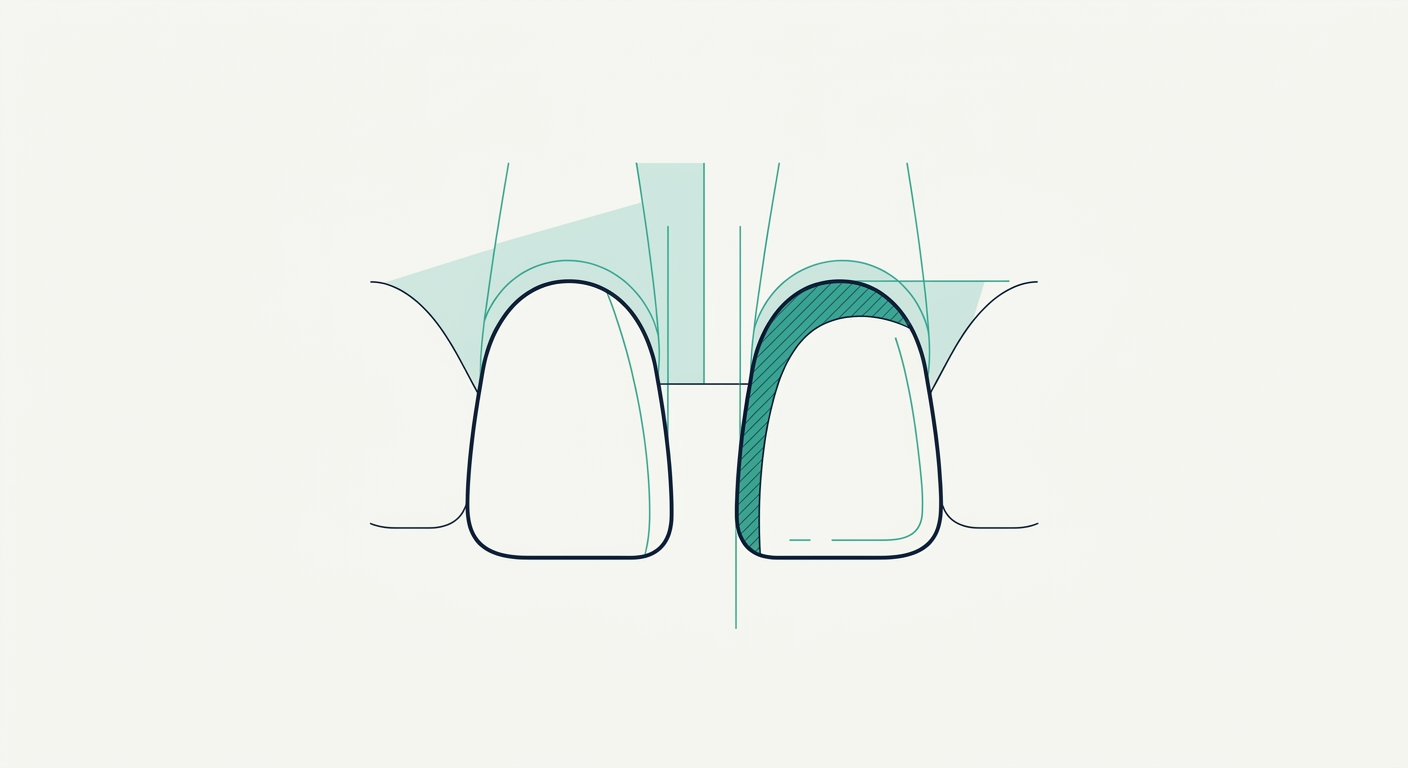
With wider diastemas, composite starts at the incisal edge, not at the gingiva
The second part of a series in the International Journal of Esthetic Dentistry describes the incisal first technique: the definitive incisal edge is placed first, and tooth proportion, the contact point and the emergence profile are derived from it.
The first increment sets the final width of the tooth
The International Journal of Esthetic Dentistry has published the second part of a series on closing diastemas with direct composite. The team around Mališauskienė describes the incisal first technique (IFT), intended for wider anterior spaces, while the first part of the series covered the modified Mylar pull technique (MMPT) for small diastemas.
The idea is to place the definitive incisal edge immediately, as the first step, and thereby define the final width of the tooth. Tooth proportion, the position of the contact point and the emergence profile are then derived from that reference. The usual approaches to wider diastemas rely on a wax-up, a mock-up or covering the entire buccal surface with composite, which complicates the workflow and can compromise a natural appearance.
The order of placement is deliberate: after the incisal edge comes the palatal and only then the buccal side, which avoids covering the whole labial surface and leaves the gingival margin untouched. For the proximal contact the Mylar strip is pulled twice, once from the palatal and once from the buccal side, because that, the authors state, closes voids in the contact and keeps the line angles under control.
The authors state that the IFT allows conservative closure of wider spaces without substantially altering the buccal surface and without additional preparatory and finishing steps, with more predictable control of proportion and contact formation.
Limitations
This is a description of a clinical technique, not a comparative study: there is no patient sample, no control group and no data on restoration survival. The claims about predictability rest on the authors' experience rather than measured outcomes, so they should be read as a proposed workflow.
For the practice
- With wider diastemas, determine the final width of the tooth before you place the first increment of composite. The incisal edge is the reference that is easiest to measure and hardest to change afterwards.
- Shape the proximal contact with a Mylar strip from both sides, palatal and buccal; a one-sided pull is the commonest source of voids and over-rounded line angles.
- If you normally make a mock-up for every diastema, try the workflow without one in simpler cases. The saving is in the preparatory and finishing steps, but there are no long-term outcome data yet.