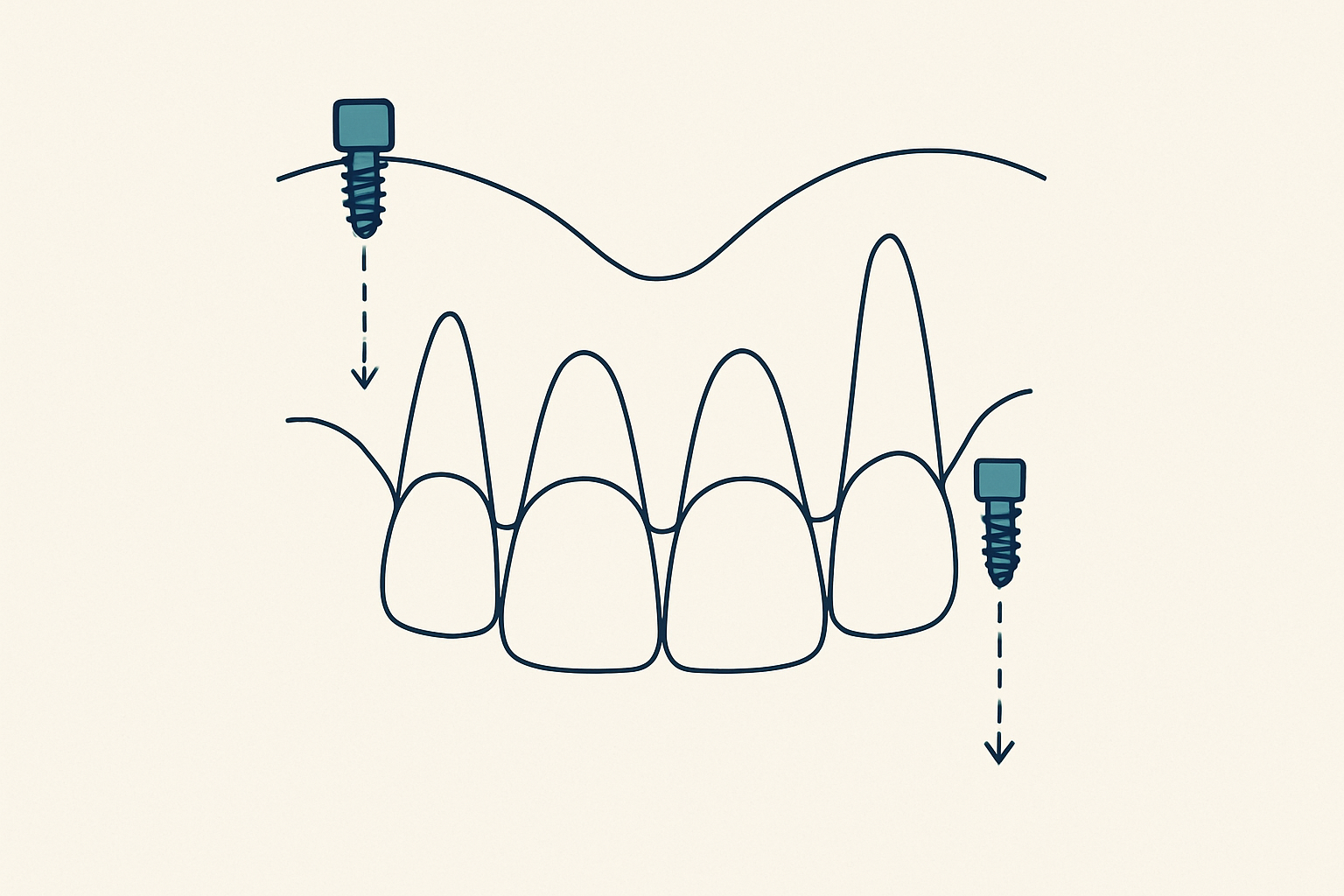
TADs at the front and back give incisor intrusion, but also more resorption
In a retrospective cohort with three anchorage patterns, only the combination of anterior and posterior mini-screws produced intrusion of the upper incisors (1.07 ± 1.64 mm), at the cost of greater apical root resorption (1.31 ± 0.91 mm).
Anterior screws were the only ones that produced intrusion
Combining clear aligners with mini-screws has become a common answer to extraction cases in which the aligner alone struggles to control inclination and the vertical dimension. The team around Zhang compared three anchorage patterns in adult patients after premolar extraction.
The retrospective cohort grouped upper central incisors by use of mini-screws: none (n = 54), posterior only (n = 50), and anterior and posterior combined (n = 46). CBCT was taken before and after treatment, and from it palatal movement of the incisors, vertical movement and retroclination were measured, along with side effects: apical root resorption, reduction of the pulp chamber and palatal dehiscence.
Both mini-screw groups achieved greater retraction of the incisors than the group without them. Vertical control, however, separated them. Only the combination of anterior and posterior screws produced intrusion (1.07 ± 1.64 mm), while the other two groups ended in extrusion: −0.46 ± 1.12 mm with posterior screws and −1.51 ± 1.29 mm without them. Retroclination exceeded 10° in all groups.
The price of better vertical control was visible. The group with anterior and posterior screws had greater apical root resorption (1.31 ± 0.91 mm) and a higher share of grade three findings, and in regression analysis the intrusion achieved was the strongest independent predictor of resorption. Reduction of the pulp chamber and the frequency of palatal dehiscence were similar across all three groups.
Limitations
The design is retrospective, so the authors themselves warn about possible residual confounding. The groups were not randomised, and the choice of anchorage pattern in practice depends on the difficulty of the case.
For the practice
- If a case calls for intrusion of the upper incisors, posterior screws alone will not deliver it; without anterior ones you end up in extrusion.
- The intrusion achieved was the strongest independent predictor of resorption, so in cases planned with anterior screws a check radiograph at the end of treatment has a rationale.
- Retroclination above 10° in all groups shows that control of inclination remains the weak point of aligners, whatever the anchorage.