Skeletal anchorage has widened non-extraction options in Class II/1
A review in the Dental Press Journal of Orthodontics presents six treatment pathways for the most common sagittal malocclusion and warns that case selection remains decisive despite advances in skeletal anchorage.
One diagnosis, six treatment pathways
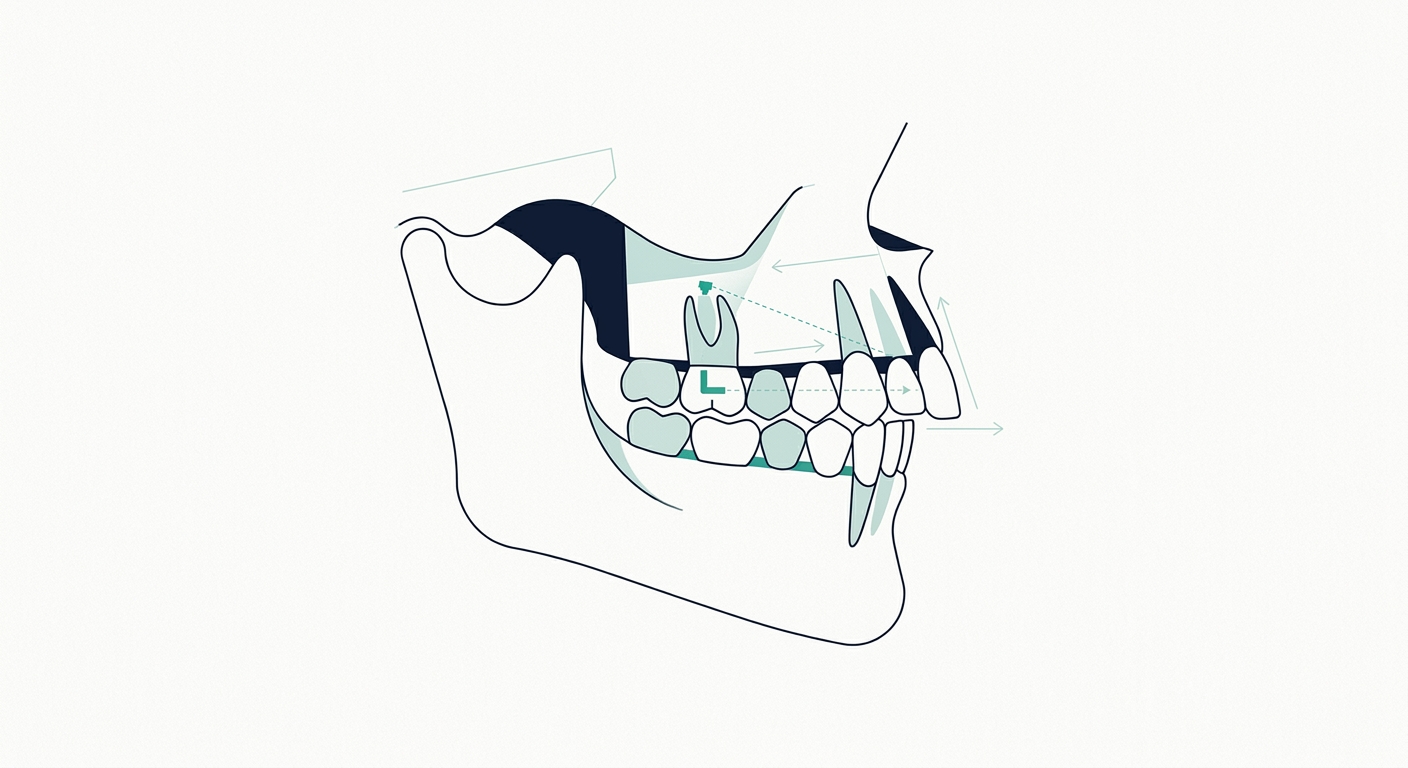
Class II, division 1 is the most common sagittal malocclusion. It is recognised by the distal position of the lower teeth, protrusion of the upper incisors, a narrow maxilla and a disharmonious facial profile. The aetiology is multiple — skeletal, dental and functional — so both the clinical presentation and the treatment pathway differ substantially from patient to patient.
In a paper published in the Dental Press Journal of Orthodontics, the team around O. M. Tanaka presented a range of clinical approaches to this malocclusion. The list includes growth modification, headgear therapy, distalisation of the upper molars with temporary anchorage devices (TAD), premolar extractions, clear aligner therapy and an orthodontic-surgical approach in pronounced skeletal discrepancies.
The point of the paper is not to rank these methods but to argue that each of them gives a good result if the patient has been selected for it. The authors state that advances in biomechanics and skeletal anchorage have widened the range of non-extraction and less invasive solutions, but that careful judgement about which patient is suited to which approach remains decisive.
The diagnostic work-up they propose comprises skeletal, dental, functional and psychosocial assessment, and the treatment decision weighs esthetics, biomechanics, stability of the result and patient compliance at the same time.
Limitations
This is a presentation of clinical approaches, not a comparative study of outcomes: there are no control groups, success rates or data on stability after retention. The conclusions on case selection reflect the authors' experience.
For your practice
- In every patient with Class II/1, record before referral whether the discrepancy is predominantly skeletal or dental and what growth stage the patient is in — this determines whether growth modification is still an option at all.
- Tell a parent who asks for treatment without extractions that skeletal anchorage and distalisation make this possible more often than before, but that the choice depends on the findings, not on the wish.
- Enter the psychosocial part of the assessment — how much the profile bothers the patient and how willing they are to cooperate — in the record; in this review it is listed as an equally important diagnostic factor.