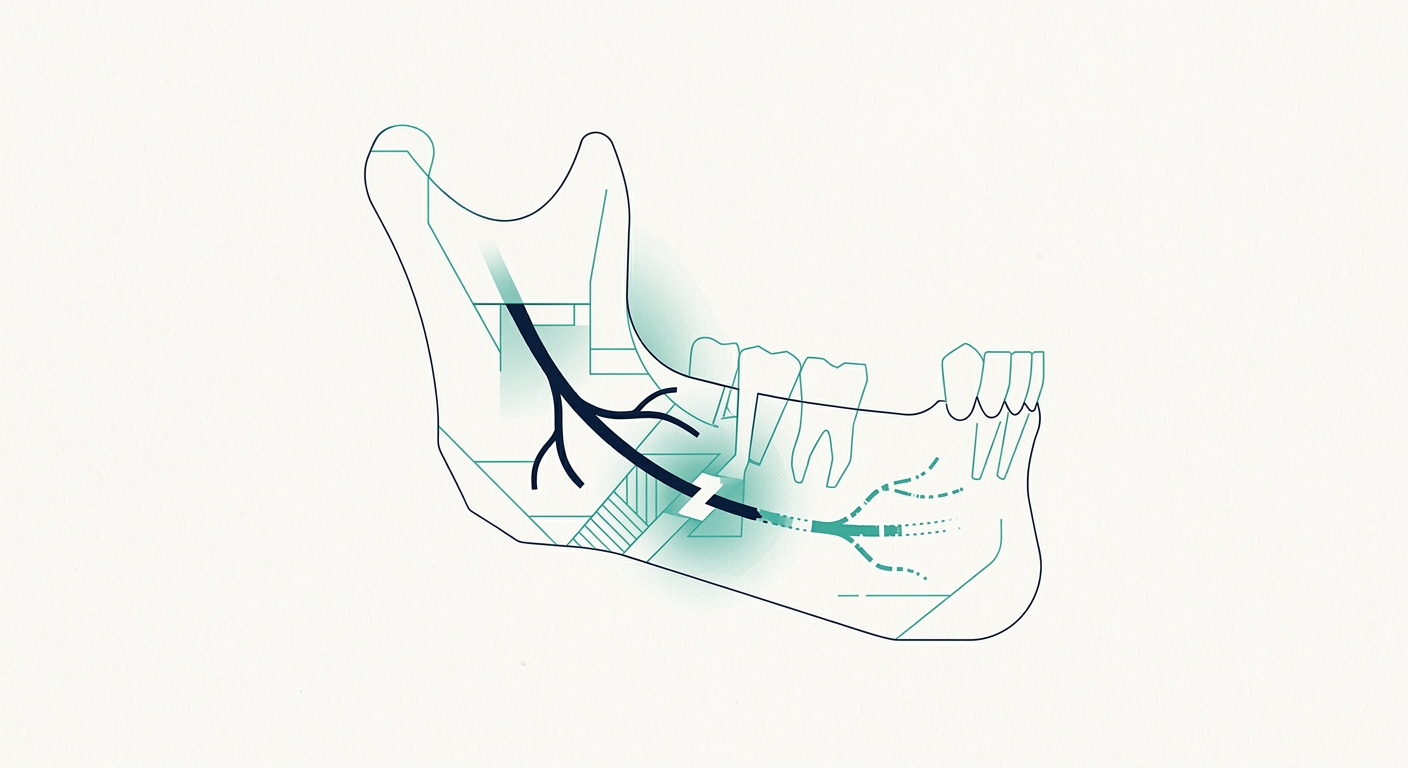
Severed inferior alveolar nerve: sensation still impaired one year after SSO
A retrospective cohort compared 11 sides with an intraoperatively severed inferior alveolar nerve against 151 sides without injury. By month 6 the uninjured sides no longer differed significantly from baseline, while the severed ones remained significantly impaired even after 12 months.
Immediate suture does not restore sensation
Sagittal split osteotomy (SSO) is a routine procedure in orthognathic surgery, and transection of the inferior alveolar nerve (IANT) is its serious intraoperative complication. The team around Kajita retrospectively reviewed patients operated on between 2016 and 2022 and separated them by operated side: 11 sides with a severed nerve (group A) and 151 sides without injury (group B).
Sensation was measured with three instruments, Semmes-Weinstein monofilaments, static two-point discrimination (s-2PD) and a numerical rating scale (NRS), before surgery and at 1, 3, 6 and 12 months after it. Group A was significantly worse than group B on every test and at every postoperative point (p < 0.01).
The within-group comparison says more than that difference. Patients without transection had significantly worse SW and s-2PD values than their own baseline at months 1 and 3, but by months 6 and 12 no longer differed significantly from it, a transient deficit that resolves on its own. Group A remained significantly impaired relative to its own baseline throughout the full 12 months of follow-up, and that despite the nerve being repaired immediately. The authors conclude that complete transection leaves a permanent neurosensory deficit and that immediate repair does not guarantee functional recovery.
Limitations
The retrospective design and the very small injured group (11 against 151 sides) limit the precision of the estimate, and the data come from a single institution. The numerical scale additionally depends on the patient's subjective report.
For the practice
- In the informed consent for an orthognathic procedure, distinguish two scenarios: transient hypoesthesia, which as a rule resolves by the sixth month, and a permanent deficit after nerve transection.
- For a patient still numb at month 3 whose nerve was not severed, these data give a reason for patience rather than for further work-up.
- If transection is documented in the operative report, plan follow-up beyond one year and do not promise a return of sensation on the basis of the suture performed.