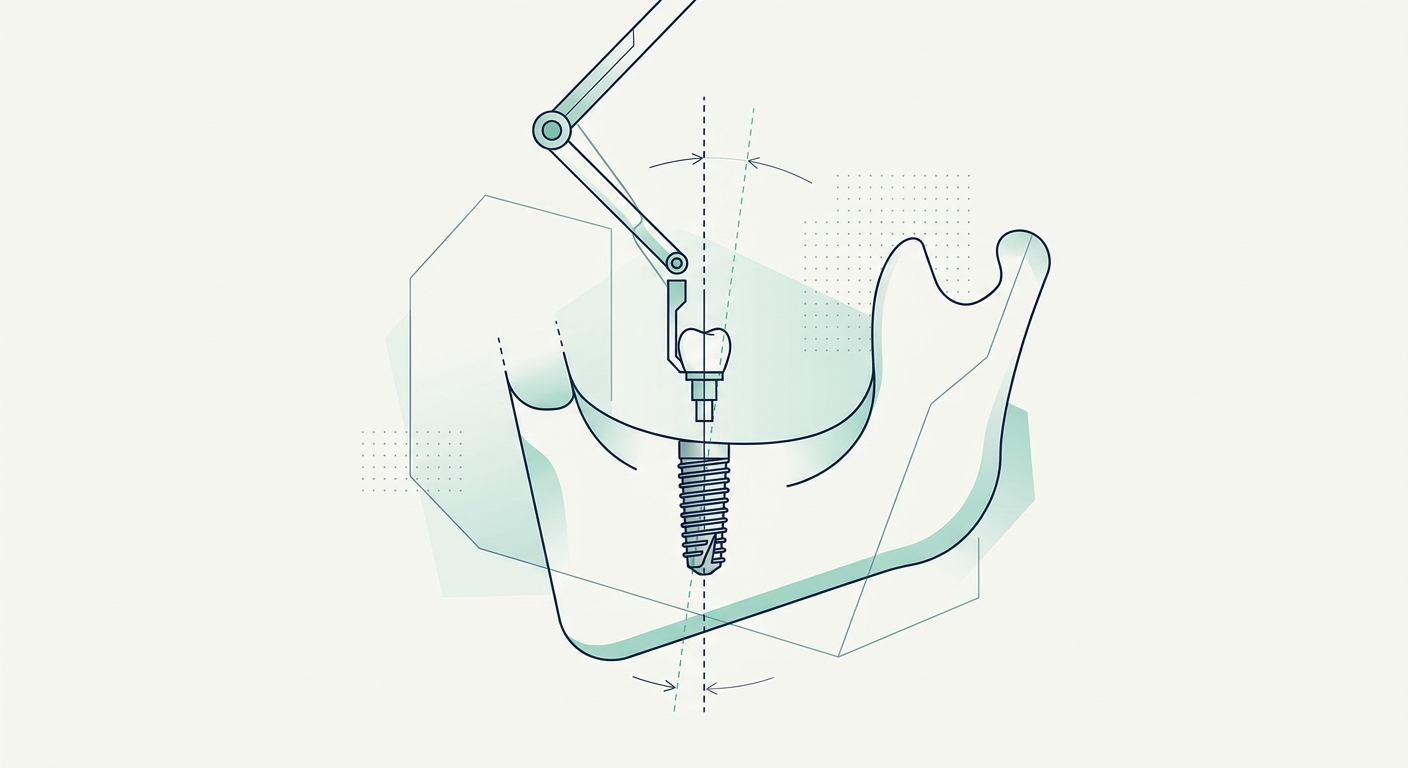
Robot placed an implant with an angular deviation of 1.33° — a single case report
In a single case report, a semi-autonomous robotic system placed an implant with an angular deviation of 1.33 degrees and a platform deviation of 0.37 mm, with a primary stability of 80 ISQ.
The surgeon supervises, the robot drills
Robotic systems in implantology promise what not even a physical surgical guide fully delivers: transfer of the planned implant position into bone without a template and without the deviations introduced by the hand. Alonso-Pérez's team described a protocol in which the plan is built backwards from the prosthetic goal, while the drilling is performed by a robot.
The patient was missing a single tooth. Before the procedure a CBCT scan was taken and an intraoral digital impression was made, and on the basis of these data the implant position and the drilling protocol were determined virtually. During the procedure the robotic system semi-autonomously performed the osteotomy and placed the implant, under the surgeon's supervision. A control CBCT was then taken and compared with the plan.
The implant was placed without major complications. Primary stability was measured at 80 ISQ. Deviations from the plan were 0.37 mm at the platform, 0.49 mm at the implant apex, 0.33 mm in depth and 1.33 degrees in axis. The authors judge these values satisfactory in terms of both stability and accuracy, and describe them as preliminary evidence that the system has a place in practice.
Limitations
This is a single case report: one patient, one implant, one operator, with no control group and no comparison with a static guide or freehand placement. There are no data on the duration of the procedure, the cost of the system or the outcome after prosthetic loading.
For your practice
- A single case does not establish that the robot is more accurate than a static guide — that is a comparison this study did not make.
- What does transfer is the logic of the protocol: the prosthetic goal defined before surgery, CBCT and an intraoral scan as the basis, and an execution that merely transfers what has been decided in advance.
- If you are following the robotic implantology market, ask for data from series with more patients and for the duration of the procedure; figures from a single procedure are not a benchmark.