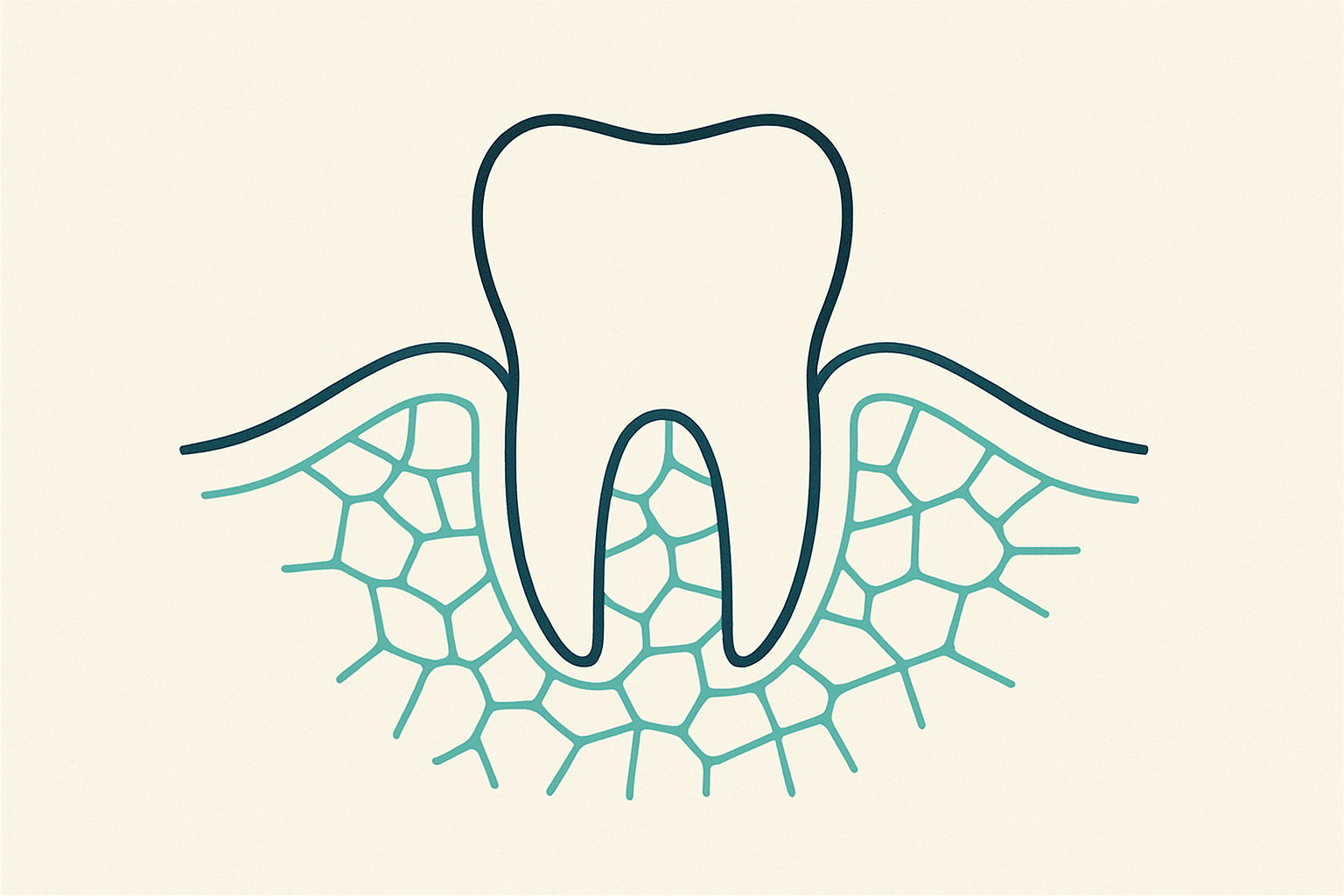
Pilot study: trabecular bone around the roots changes with taurodontism
A radiomic analysis of panoramic radiographs of 24 children separated taurodontism from controls with an AUC of 0.824, and only in the interradicular region.
The signal is strongest between the roots
In practice, taurodontism is mostly treated as a morphological peculiarity with consequences for endodontics. The group around Tasdemir asked a different question, the one in the title of the paper: is taurodontism more than a dental anomaly, that is, does the bone around such a tooth change as well.
Panoramic radiographs of 24 children were analysed retrospectively, six of them with taurodontism and 18 age-matched controls. Because root development was incomplete, severity was assessed qualitatively, by Shaw's criteria. Trabecular bone was analysed by a radiomic procedure in 3D Slicer, compliant with the IBSI standard, in four topographic regions: the interradicular epicentre, the mesial and distal apex, and the gonial angle. Diagnostic performance was assessed preliminarily by ROC analysis.
The differences showed a clear spatial gradient. They were most pronounced in the interradicular region and weakened towards the mesial, distal and gonial ones. In the interradicular regions of interest, four higher-order radiomic features were statistically significant (all p < 0.05). The best discrimination came from the GLSZM ZoneVariance feature with an AUC of 0.824 (95% CI 0.617–0.948), with sensitivity of 100% and specificity of 72.2%, followed by ZoneEntropy with an AUC of 0.815. From this the authors infer that a routinely taken panoramic radiograph can offer supplementary imaging features for the study of developmental dental phenotypes.
Limitations
The sample is very small, just six cases against 18 controls, so the confidence interval is wide (0.617–0.948). The authors describe the work as a proof of concept that requires prospective multicentre confirmation with external validation.
For the practice
- The finding does not change today's work, but it raises the possibility that taurodontism is not an isolated dental phenomenon but a local developmental pattern.
- The panoramic radiograph you take anyway carries more information than the eye reads, and radiomics extracts it from that same, already existing image.
- In children with taurodontism it is worth recording the finding in the chart; if the link is confirmed, retrospective data will be the only source.