Orthodontics alters the condyle in Class II division 2, but not in division 1
A retrospective CBCT analysis of 82 adult patients showed that after orthodontic treatment the temporomandibular joint remains structurally stable in Class II division 1, while in division 2 the condyles lengthen bilaterally and their inclination changes.
Two divisions of the same class, two outcomes for the joint
The authors of a study published in the journal Clinical Oral Investigations retrospectively analysed 82 adult patients (43 women and 39 men, aged 18 to 35 years) treated for Class II malocclusion — 54 of them with division 1 and 28 with division 2. CBCT scans were taken before and after treatment to assess the morphology and position of the temporomandibular joint, and mandibular function was measured with an electronic articulator.
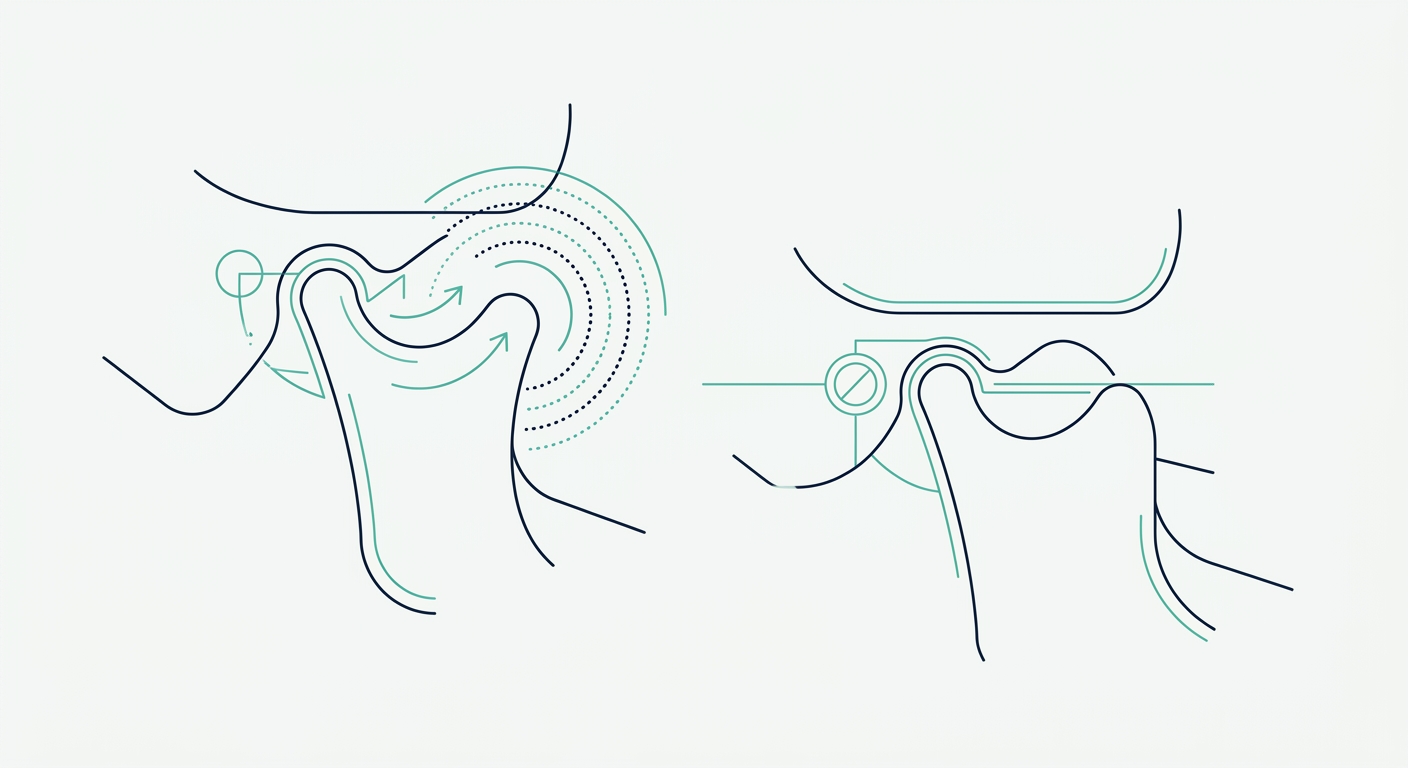
In division 1 the joint remained almost untouched: condylar size, sagittal inclination, joint spaces and the shape of the glenoid fossa did not change significantly after treatment (P > 0.05). The only significant functional change was a shortening of the protrusive path measured at the incisal point (P = 0.020). Subgroups by extraction pattern — 20 patients without extraction, 13 with extraction in one arch and 21 with extraction in both — were analysed only exploratively, and the authors explicitly warn that no conclusions about the effect of extractions on the joint may be drawn from them.
In division 2, where all patients were treated without extractions, the picture is different. Condylar length and height and sagittal inclination increased significantly on both sides. The anterior joint spaces bilaterally and the left superior space decreased, while the posterior spaces increased bilaterally; the angle of the protrusive condylar path also decreased bilaterally. Functional measurements — protrusion, laterotrusion and mouth opening and closing — remained unchanged.
Limitations
The retrospective design without a control group does not separate the effect of treatment from natural joint remodelling, the extraction subgroups are too small for conclusions, and there are no data on the long-term stability of the findings after treatment ends.
For your practice
- In patients with division 2, the pre-treatment discussion should also cover the joint: changes in condylar dimensions and joint spaces are expected here, not a complication.
- Before-and-after CBCT is not routinely justified in division 1 — in this sample nothing structural changed significantly there in the main analysis.
- The shortening of the protrusive path in division 1 is a reason to perform functional measurements after appliance removal as well, not only before treatment.