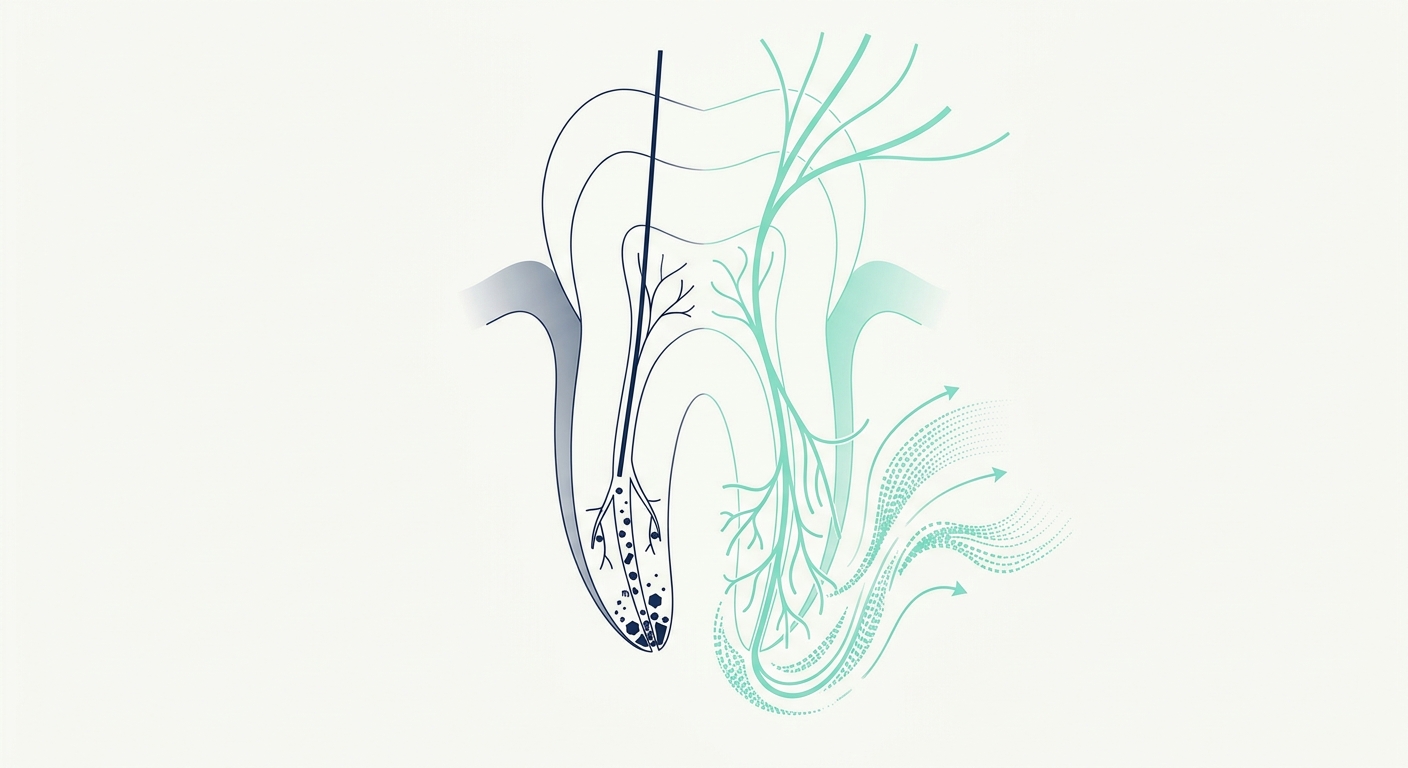
Only EDDY and SWEEPS outperformed the needle in the apical third of the canal
In an SEM analysis of 40 roots all irrigant activation techniques outperformed the conventional needle in the middle third of the canal, but in the apical third only EDDY and SWEEPS retained the advantage.
The advantage of activation depends on the canal third and on what is being removed
There are more technical designs for irrigant activation on the market than the average practice keeps on the shelf. The authors compared four systems with conventional needle irrigation and, more importantly, broke the result down by canal thirds.
Forty human single-rooted premolars were instrumented to the same size and randomly divided into five groups of eight samples: conventional needle irrigation, EDDY, Gentlefile, passive ultrasonic irrigation and SWEEPS. The roots were then split longitudinally, and the amount of remaining debris and smear layer in the cervical, middle and apical thirds was scored with a scanning electron microscope. The scores were analysed with the Kruskal-Wallis and Dunn post-hoc tests with Bonferroni correction.
For debris removal EDDY and SWEEPS were significantly better than the needle in the cervical and apical thirds (p < 0.05), while passive ultrasonic irrigation and Gentlefile were not. In the middle third all four activation techniques outperformed the needle (p < 0.05).
For the smear layer the picture is stricter. In the cervical third only SWEEPS was better than the needle (p < 0.05), in the middle third all techniques were again better (p < 0.05), and in the apical third EDDY and SWEEPS retained the advantage (p < 0.01), while passive ultrasonic irrigation and Gentlefile did not. The conclusion of the team around Y. Tu is that the effectiveness of activation depends both on the part of the canal and on whether debris or the smear layer is being removed.
Limitations
Eight samples per group and a single morphology, single-rooted premolars, limit transferability to curved and multi-rooted teeth. Scoring under the electron microscope is semi-quantitative, and a clean canal wall is not the same as the outcome of endodontic treatment.
For your practice
- If you are choosing a single activation technique, in this study EDDY and SWEEPS had the advantage in the apical third.
- For the middle third the choice of system was not decisive; there every form of activation was better than the needle alone.
- The cervical third is the most accessible, but there only SWEEPS was better than the needle at removing the smear layer, so do not assume in advance that it is taken care of.