ONE File: a proposal for a sixth generation of endodontic instruments from a 3D printer
The Journal of Endodontics has published the ONE File concept, a 3D-printed instrument of thermoplastic polyurethane with a hollow diamond lattice and combined rotary-vibratory motion, compared by finite element analysis with the ProTaper Gold F2.
A sixth generation on paper: a hollow lattice instead of a solid NiTi core
Endodontic instrumentation has gone through five technological generations, each arising as an answer to the weakness of the previous one. A paper published in the Journal of Endodontics proposes a theoretical construct for a sixth, an instrument named ONE File.
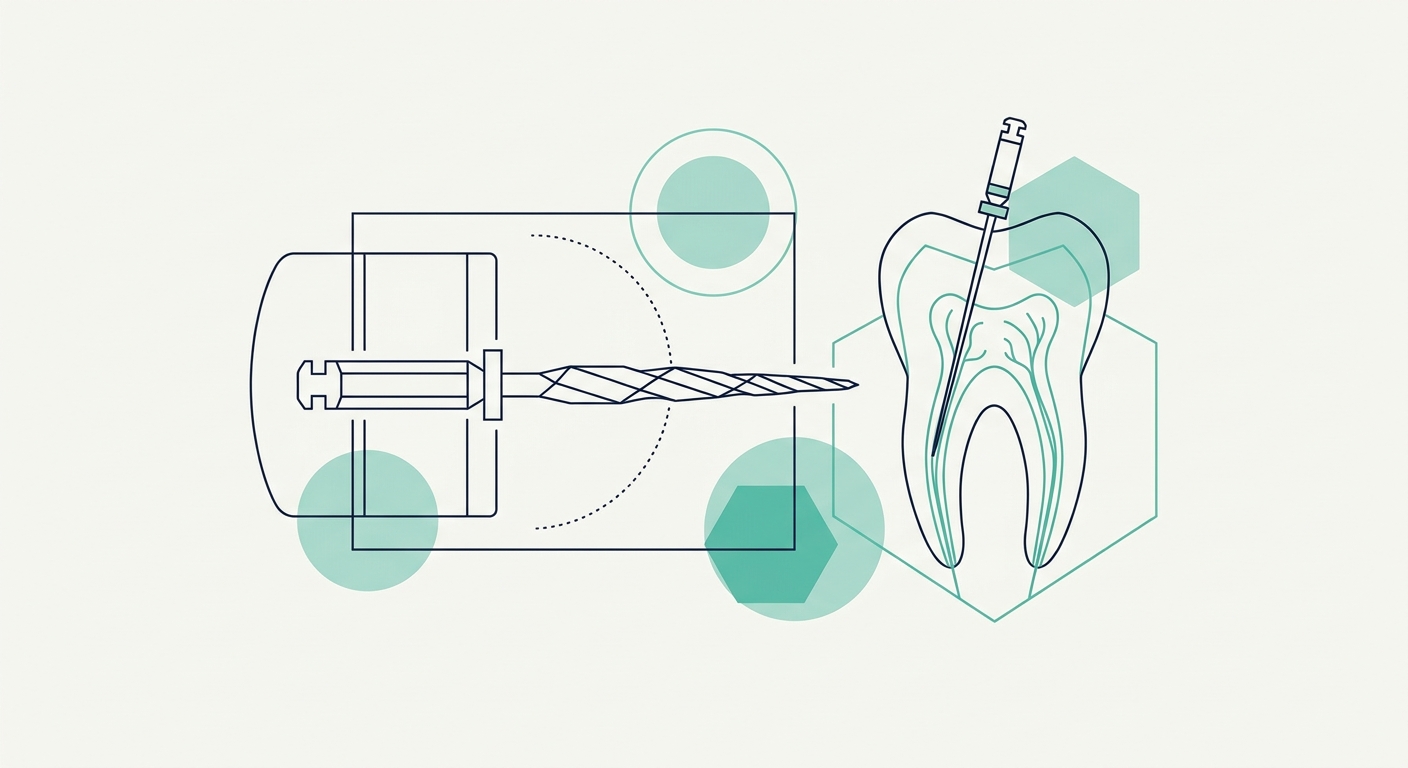
The idea departs from what is in the box today. Instead of a solid nickel-titanium wire, the ONE File is 3D printed from thermoplastic polyurethane (TPU) and hollow inside, with a wall built as a diamond lattice. The intended motion is not purely rotary but combined rotary-vibratory. Material and geometry thus change at once: a more elastic polymer should follow the curvature of the canal, and the lattice interior should distribute stress instead of concentrating it in a solid core.
The author, Albaraa Alkady, did not test the idea in a canal but in a computer. By finite element analysis (FEA) he examined stress distribution, deformation behaviour and biomechanical safety of the ONE File compared with the ProTaper Gold F2 (Dentsply Sirona, Ballaigues, Switzerland), tip diameter 0.25 mm, taper 0.08, made of heat-treated gold NiTi wire. The choice of comparator is not accidental: that instrument represents the fifth generation against which the new concept is measured.
The available abstract gives the idea, the method and the comparator, but not the numerical results of the simulation, neither how much lower the stress is, nor the difference in deformation, nor the calculated safety factor. Until the full paper can be read, the ONE File remains what the author himself says it is: a theoretical construct.
Limitations
Finite element analysis is a computer simulation, not a clinical or laboratory test. It says nothing about cutting dentine, resistance to cyclic fatigue in a curved canal, or how a polymer instrument behaves in sterilisation. One instrument was compared with one comparator.
For the practice
- Nothing changes in the protocol: the ONE File does not exist as a product on the market, only as a published concept.
- The direction of development is worth remembering: polymers and 3D printing are entering territory that until now belonged to nickel-titanium wire.
- When the first laboratory studies appear, look for data on cyclic fatigue and torsional resistance rather than simulation results.