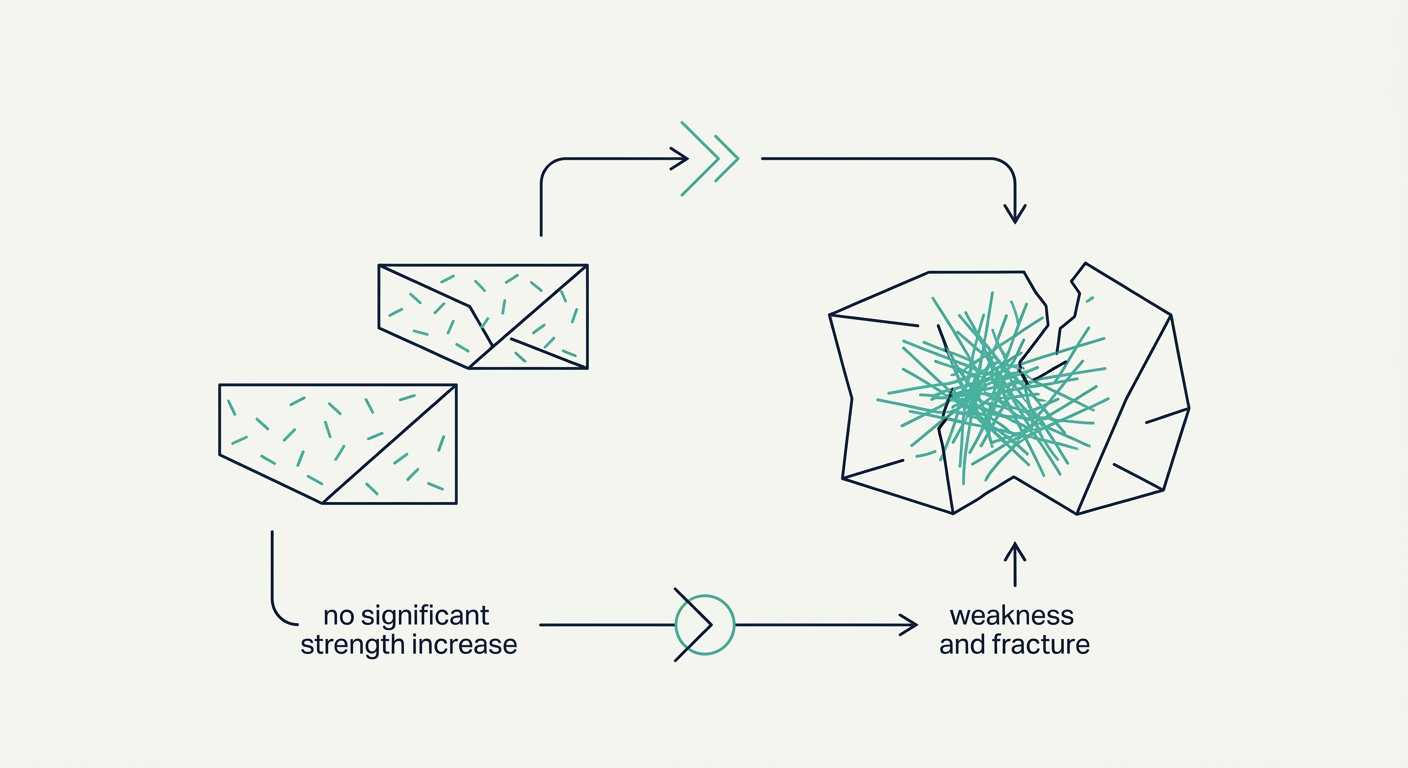
Nanofibres do not strengthen PMMA denture bases, and at higher loadings weaken them
A meta-analysis of six studies selected from 1,893 screened papers found no difference in flexural strength between nanofibre-reinforced and conventional PMMA at any concentration tested. At higher fibre loadings conventional PMMA was stronger (p < 0.0001).
Reinforcement that does not show up in the numbers
The idea is logical: nanofibres are added to denture base acrylic and the result is a material that fractures less. A series of laboratory papers has been published on this premise, but without a common conclusion. The team around Rangel therefore carried out a systematic review following the PRISMA guidelines, with a protocol registered on the Open Science Framework platform, and searched seven databases: Medline/PubMed, Scopus, Cochrane Library, Web of Science, EMBASE, Lilacs and SciELO.
Of 1,893 screened papers, six met the criteria. The nanofibres tested were carbon, acrylonitrile butadiene styrene, polyamide-6, polystyrene, cellulose, PMMA-cerium and polyvinyl alcohol, at loadings of 0.1 to 23 percent. The papers measured impact and flexural strength, fracture resistance, hardness, elasticity, toughness, surface roughness, contact angle and colour. Quantitative synthesis was possible only for flexural strength — the only property measured in all the included studies.
The result is an absence of effect. There was no difference in flexural strength at any concentration tested: 0.5 percent (p = 0.554), 1 percent (p = 0.847), 3 percent (p = 0.9825) and 5 percent (p = 0.222). The subgroup analysis went a step further — conventional PMMA showed greater flexural strength than the reinforced material, particularly at higher nanofibre loadings (p < 0.0001). The qualitative review of the other properties produced inconsistent findings, so the authors call for standardised laboratory and clinical studies.
Limitations
The synthesis rests on only six studies with very different fibre types and loadings, so heterogeneity is high. The data are predominantly in vitro and do not translate directly into how a denture behaves in the mouth.
For your practice
- The claim that a base is reinforced with nanofibres has no backing in flexural strength for now — ask for data on the specific material and the fibre loading, not on the category.
- In a patient with repeated denture fractures, check the occlusion, the thickness of the base and the support before changing the material; the evidence for a material solution is weak.
- A higher fibre loading is not better: the subgroup analysis points in the opposite direction from the one expected.