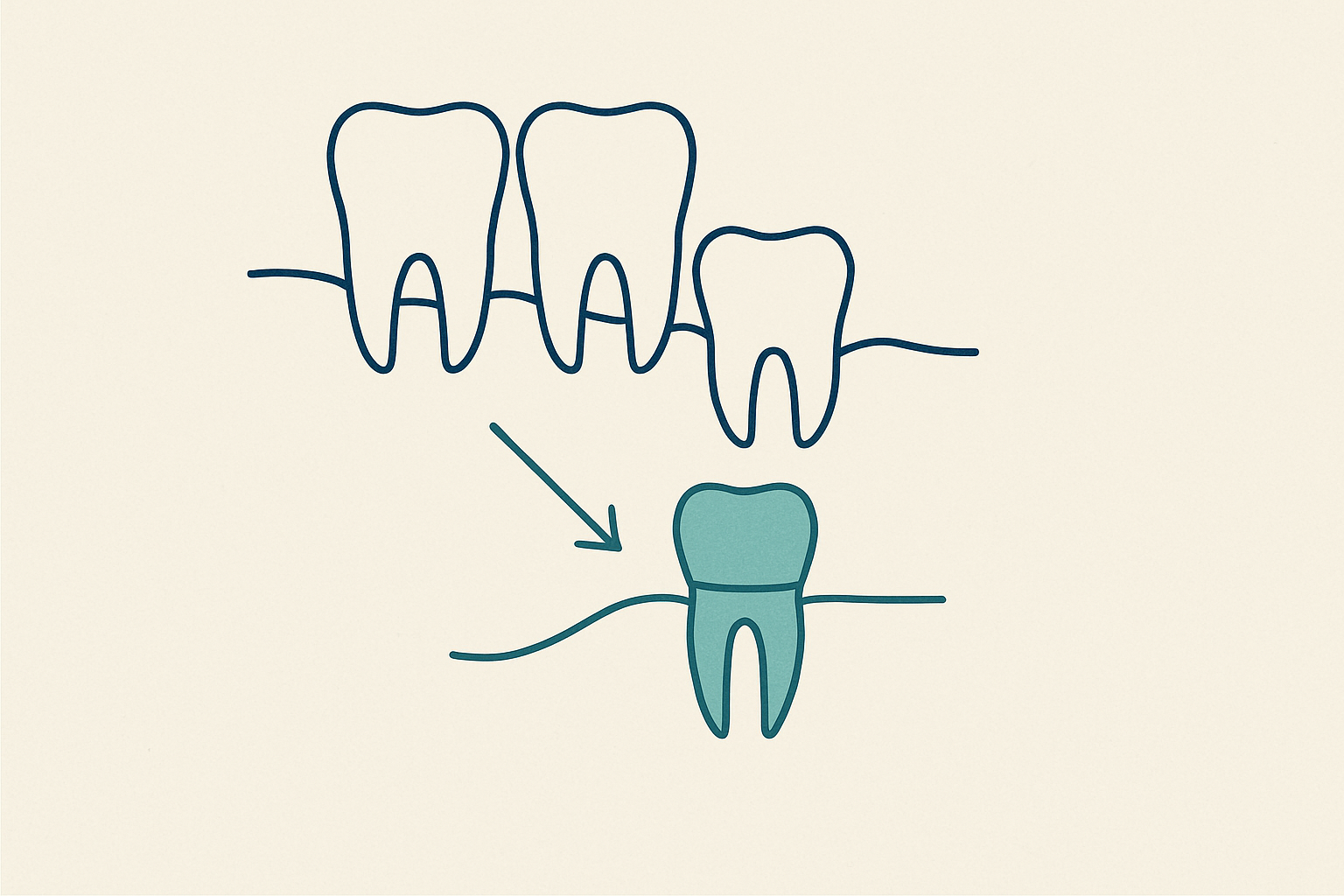
Infraocclusion of a primary molar raises the odds of agenesis almost 148-fold
Across 4,990 panoramic radiographs, agenesis was found in 6.1 percent of patients, and the strongest association was with infraocclusion of a primary molar (OR 147.73; p < 0.001).
Agenesis rarely comes alone
A panoramic radiograph showing that a tooth simply never developed is rarely the end of the story. A cross-sectional study from Uberlândia in Brazil, by the team around Borges, went through 4,990 panoramic radiographs from radiology centres to measure how often agenesis comes packaged with other developmental dental anomalies, and whether it can be predicted.
Agenesis was found in 6.1 percent of patients, more often in women (57.6 percent) and in younger participants (mean age 16.8 years). Alongside agenesis the researchers looked for palatal displacement of the canine, distoangulation of the lower second premolars, tooth transposition, infraocclusion of primary molars, mesioangulation of the lower second molars and supernumerary teeth, and mapped the patterns of occurrence with the TAC code.
Three associations proved significant, and in entirely different orders of magnitude. Infraocclusion of a primary molar carried odds almost 148 times higher (OR 147.73; p < 0.001), tooth transposition about 19 times (OR 19.11; p < 0.001), and palatal displacement of the upper canine twice (OR 2.08; p < 0.001). On the same data the authors also tested machine learning models: a decision tree, Random Forest, XGBoost, support vector machines and deep learning. Random Forest showed the best predictive performance, but the authors themselves warned about the clinical limits of such prediction.
Limitations
A cross-sectional design on radiographs from a single region; a sample from radiology centres is not a representative sample of the general population, and the machine learning models were not externally validated.
For the practice
- When you see an infraoccluded primary molar on a radiograph, check the successor and the rest of the dentition deliberately. It is the strongest signal in this work.
- Transposition and a palatally positioned canine call for the same logic: finding one anomaly changes the assumed probability of another.
- A panoramic radiograph in the mixed dentition remains the cheapest way to set an orthodontic plan before a missing tooth becomes a prosthetic problem.