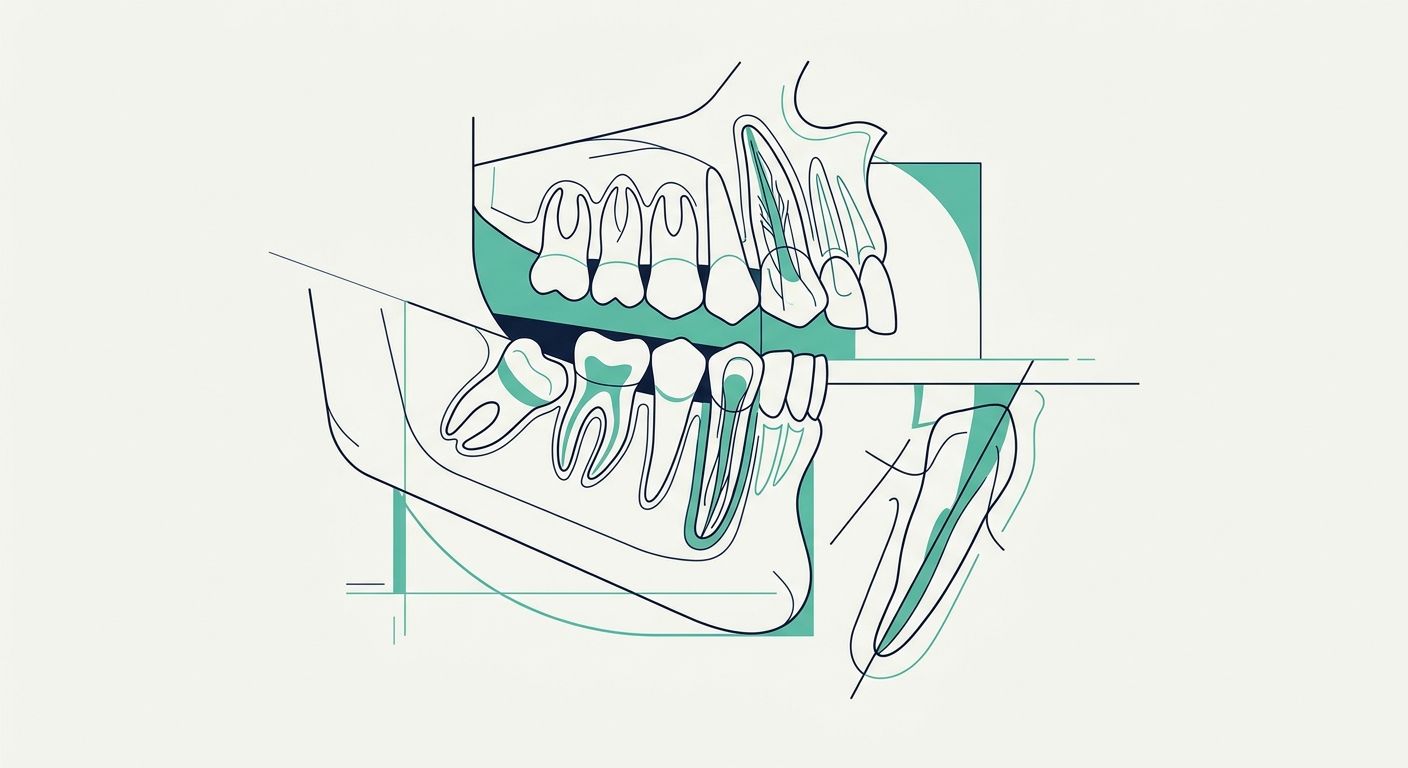
In an impacted incisor, root development matters more than rapid crown alignment
A comparison of two cases showed that root-oriented traction produced a greater root volume and surface area than conventional orthodontic traction after closed surgical exposure.
Root-oriented traction produced a more extensive root
An impacted maxillary central incisor is rarely only an orthodontic problem: surgical exposure is followed by traction on a tooth whose root is not yet complete, so every decision about force has a consequence that is not visible on the crown. The authors compare two cases in order to show how much the choice of technique changes what remains beneath the enamel.
In the first case the usual combination was applied: closed surgical exposure and conventional orthodontic traction. In the second, root-oriented traction was used — an approach that reduces resistance to root development and relies on the natural force of eruption instead of overriding it with orthodontic force.
Both cases ended in successful eruption and alignment of the tooth, so the difference is visible not in the esthetic outcome but in the root. The root-oriented approach produced a greater root volume and a greater root surface area, and a lower risk of premature closure of the apex. The authors' conclusion inverts the usual priority: the primary goal in managing an impacted maxillary incisor should be root development, not rapid crown alignment.
Limitations
This is a report of two cases, without a control group, without randomisation and without numerical values in the abstract, so the difference in root volume cannot be quantified or attributed to the technique alone. The duration of follow-up and the source of funding are not stated.
For your practice
- Before applying traction to an impacted incisor with an incomplete root, agree the force vector and magnitude with the orthodontist: the price of speed is paid in root length.
- Document the stage of root development before the procedure and at follow-up visits, so that you do not judge the outcome by crown position alone.
- Tell parents in advance that treatment will take longer — slower eruption here is intentional, not a complication.