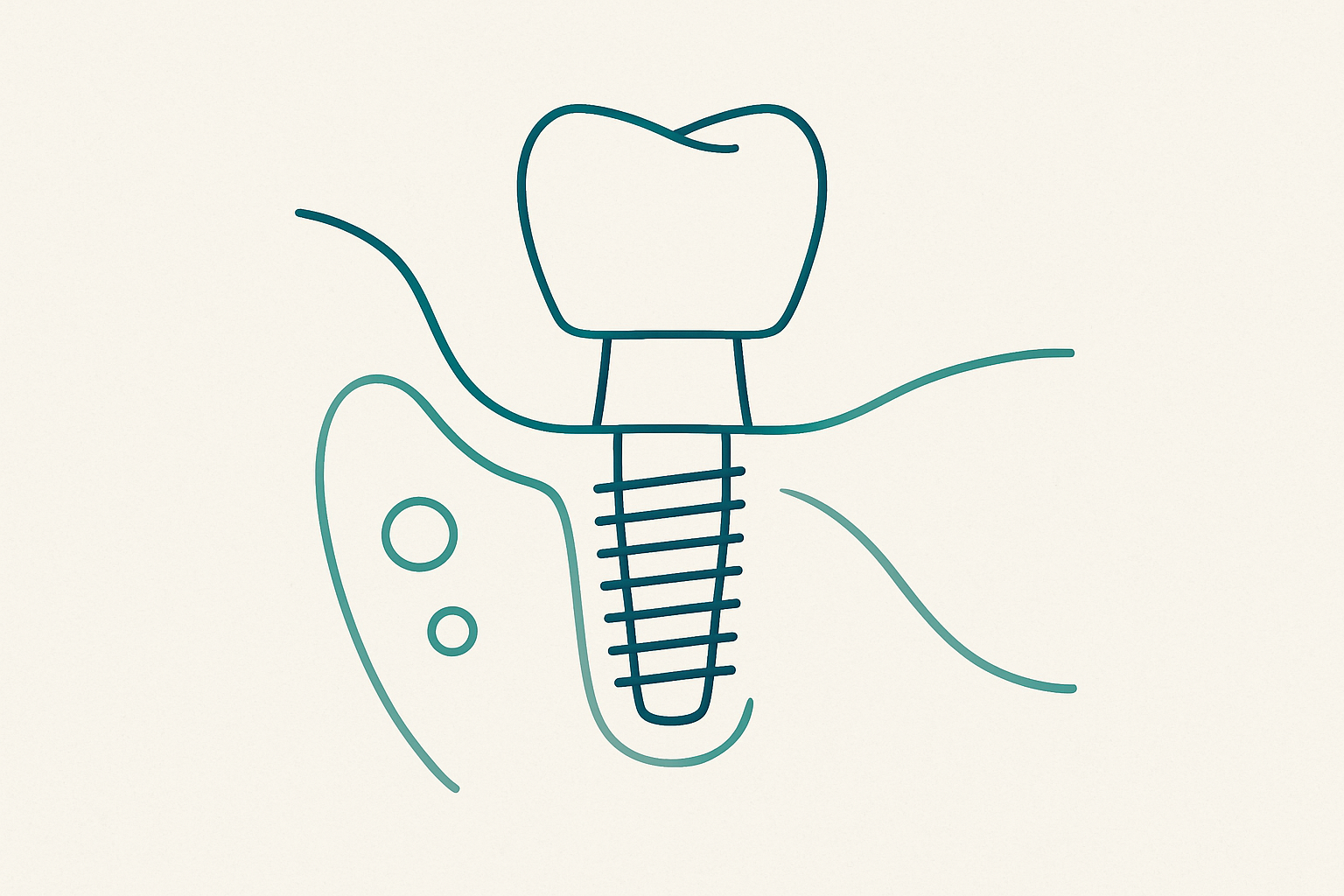
Finished zirconia crown on the day of implant placement: 9 of 12 needed no adjustment
In a proof-of-concept study on 12 patients, a definitive monolithic zirconia crown was delivered on the day of extraction and immediate implant placement, in nine of them without a single adjustment. Mean patient satisfaction after six months was 9.6.
The crown was made before surgery and delivered the same day
The team around M. Kheur reported in The International Journal of Esthetic Dentistry on a proof-of-concept study of a digital protocol in the esthetic zone. Twelve consecutive patients were included whose tooth had to be extracted and an implant placed immediately. The difference from the usual sequence: the definitive monolithic zirconia crown was fabricated before surgery, based on a restoration-driven plan, rather than afterwards from a provisional.
All patients underwent extraction and guided surgery, and the implant was immediately placed and loaded with that pre-fabricated definitive crown on the same day. The restorations were assessed both by the patients and by two experienced, calibrated clinicians using modified USPHS criteria.
In 9 of 12 patients the crown was seated at the same visit without a single adjustment. Two required a minor correction — one the position of the incisal edge, the other the distal contact point — and were also delivered the same day. One crown did not seat, so a new scan and laboratory rework were needed and it was delivered the following day. Patient satisfaction was 9.41 ± 0.49 at baseline and 9.6 ± 0.47 after six months, and peri-implant soft-tissue health, interdental papilla levels and the mid-facial mucosa were measured at both time points.
Limitations
The sample is very small (12 patients), there is no control group, and follow-up is six months; the authors themselves call for randomised controlled trials before the protocol is declared proven.
For your practice
- If you perform immediate implant placement in the esthetic zone, a fully digital workflow allows the definitive restoration to be ready before surgery — but plan the rework scenario in advance as well.
- Warn the patient that a minor adjustment of a contact point or incisal edge, or even a one-day delay, is not a failure but part of the protocol.
- This is proof of feasibility, not proof of superiority: with complex anatomy or uncertain primary stability, a provisional restoration still has its place.