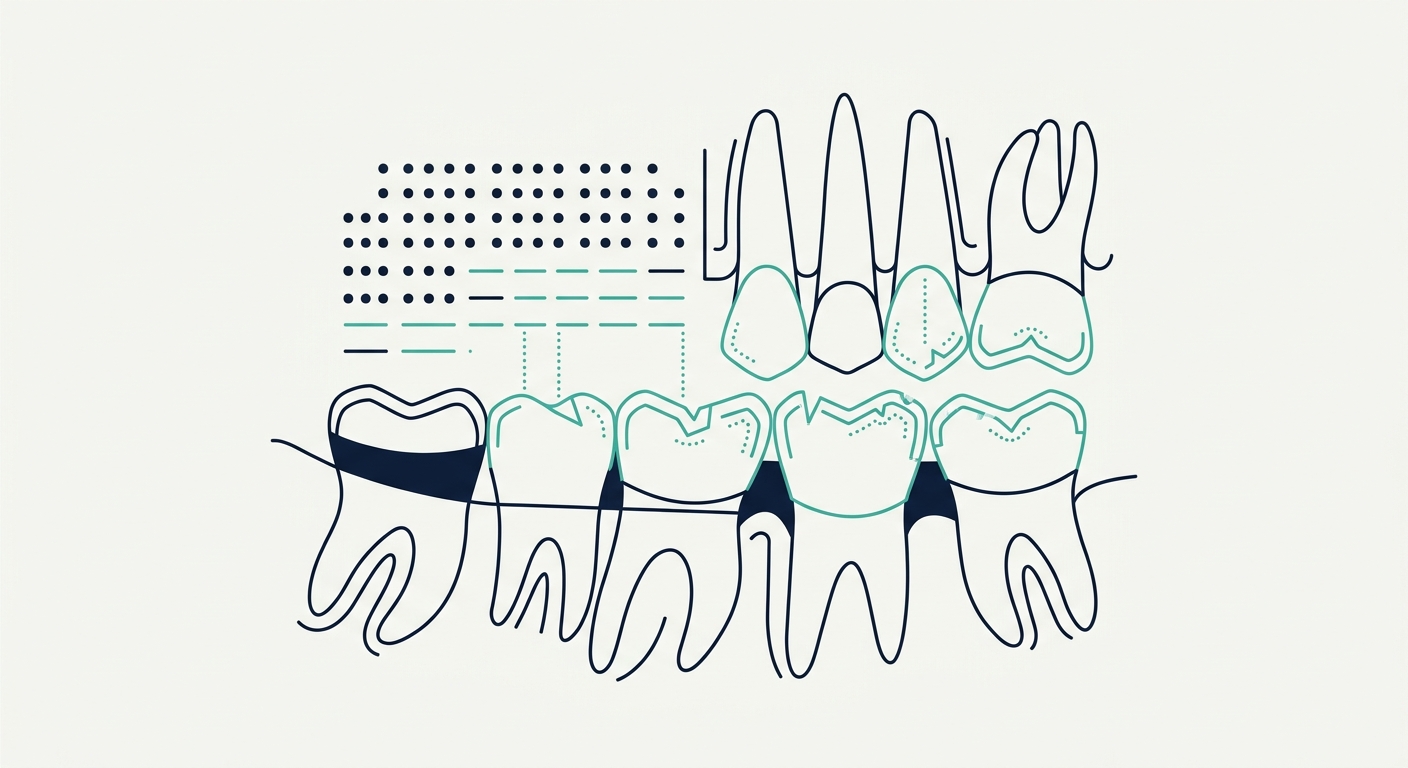
Enamel defects in 19 of 25 reported cases of HADDTS syndrome
A review of all 25 published cases of HADDTS syndrome showed enamel defects in 19 of 25 patients, that is 76%, together with developmental delay in all 25.
The tooth as a visible trace of a rare neurodevelopmental disorder
HADDTS (OMIM #617915) is an ultra-rare autosomal dominant disorder caused predominantly by de novo pathogenic variants of the CTBP1 gene, which encodes an NAD(H)-dependent transcriptional corepressor. Its very name, composed of hypotonia, ataxia, developmental delay and tooth enamel defects, places the dentist in an unusual position: the enamel finding is part of the definition of the syndrome.
The team led by Akdaş searched the literature and databases up to July 2026, among them PubMed, ClinVar, DECIPHER, OMIM, preprint servers and a foundation dedicated to the disease, and found 25 peer-reviewed cases from at least 11 countries; registries point to at least 50 known patients.
The frequency of features in those 25 cases: global developmental delay and speech impairment in all 25 (100%), intellectual disability in 24 (96%), hypotonia in 22 (88%), ataxia and enamel defects in 19 each (76%), cerebellar atrophy in 18 (72%), feeding difficulties and myopathy in 15 each (60%), regression in 10 (40%), oculomotor apraxia in 7 (28%), scoliosis in 6 (24%), mitochondrial respiratory chain dysfunction in 5 (20%) and seizures in 2 (8%). The recurrent p.Arg342Trp variant lies behind 84 per cent of cases, and in all four carriers of other variants the canonical tetrad was incomplete. Mutated CTBP1 acts in a dominant-negative manner and heterodimerises with its paralogue CTBP2, by which the authors explain the multisystem severity of the clinical picture.
Limitations
This is a review of published case reports, a design prone to publication bias towards more severe phenotypes. The percentages refer to the 25 described individuals, not to the entire population of affected people.
For your practice
- In a child with hypotonia, ataxia and developmental delay, a generalised enamel defect is not an incidental finding but a detail worth mentioning in the referral to a geneticist.
- Three quarters of affected people have enamel defects and 60 per cent have feeding difficulties: a combination that calls for a more intensive preventive protocol and a shorter recall interval.
- If a variant in the CTBP1 gene is recorded in the patient's documentation, allow also for muscle weakness, which changes the planning of the duration of the procedure and of the patient's position in the chair.