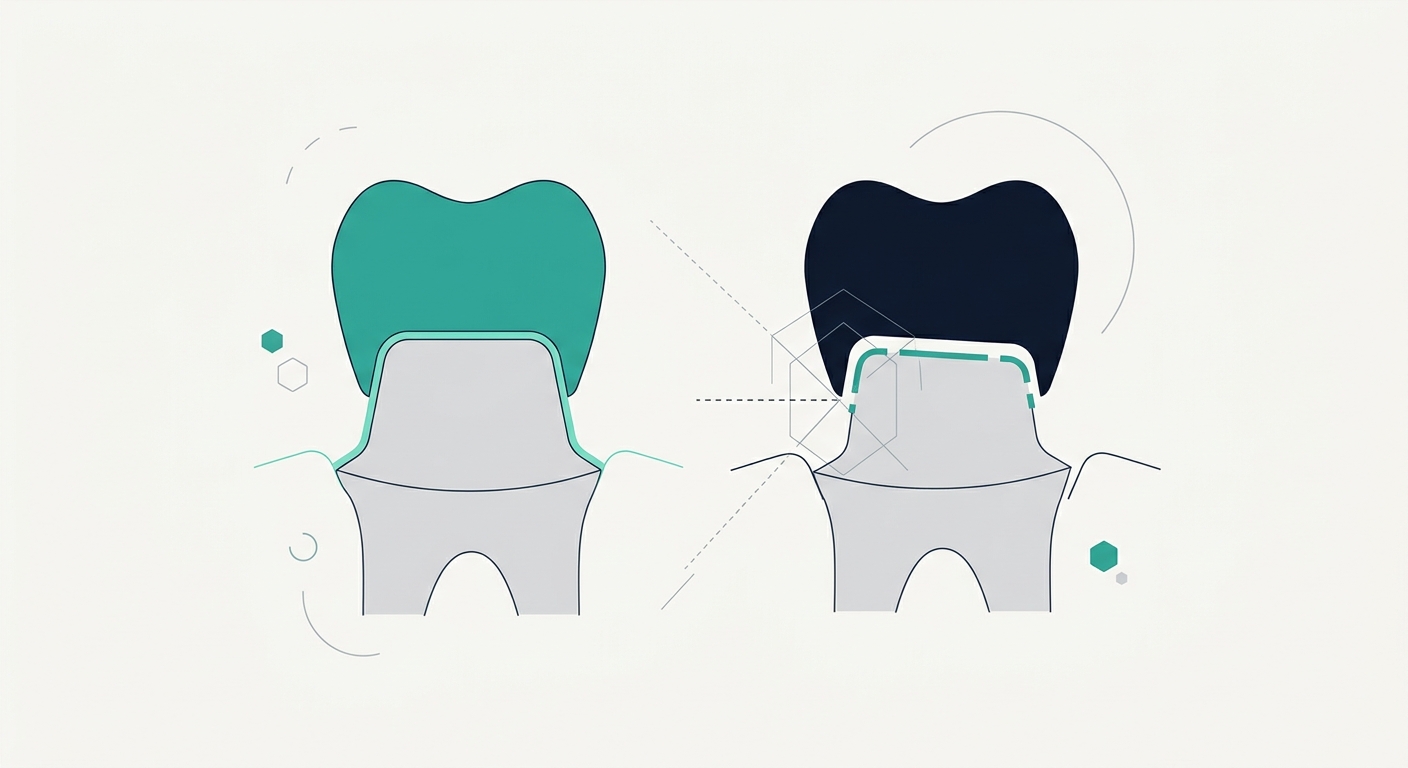
Ditching the stone die worsened marginal fit to 0.147 mm
Crowns made on non-ditched stone dies had a mean marginal discrepancy of 0.086 mm, and those made on conventionally ditched dies 0.147 mm — above the clinical threshold of 120 µm.
The scanner penalises what used to help the conventional technique
Ditching the stone die below the preparation margin is a standard step in the dental laboratory: it exposes the margin, makes waxing easier and prevents the crown from binding on the model. In a digital workflow, however, the die is no longer viewed by the technician but by the scanner, and that changes the calculation.
The team led by Adawi prepared a typodont mandibular first molar for a full crown and reproduced it as 20 stone dies. Half were ditched by a standardised procedure (group CD) and half were only minimally cleaned (group CN), ten in each; the original typodont served as the reference. After scanning, digital design and milling, cobalt-chromium crowns were produced, and marginal fit was measured by superimposing STL files at eight measurement points.
Crowns from non-ditched dies showed a mean discrepancy of 0.086 ± 0.070 mm, and those from ditched dies 0.147 ± 0.200 mm. Group CN remained within the clinical acceptability threshold of 120 µm, while the values of group CD exceeded that threshold; the discrepancies were most pronounced buccally. The authors attribute this to a loss of stability in registering the finish line during scanning — the scanner loses a clear reference where the stone has been removed.
Limitations
An in vitro experiment with ten dies per group, one crown material and one digital workflow. The scatter in the ditched group was large (± 0.200 mm), and the abstract does not state the level of significance for the main comparison, so the difference should be read as a direction, not as proof.
For your practice
- If your laboratory works digitally, ask whether it ditches the dies before scanning — in this procedure that cost marginal fit.
- A clear and uninterrupted finish line in the preparation and in the impression is worth more than exposing the margin on the model afterwards.
- The buccal surface is where the discrepancy shows up first; check the margin there with a probe and on a check radiograph before cementation.