Deep learning from cephalograms identifies the coarse growth stage in 89.8% of cases
In 3,703 patients, a deep learning model assessed skeletal maturity from the lateral cephalogram with 89.8% accuracy in the three-group classification, against 75.2% from the orthopantomogram.
The cephalogram outperformed the orthopantomogram in every scheme
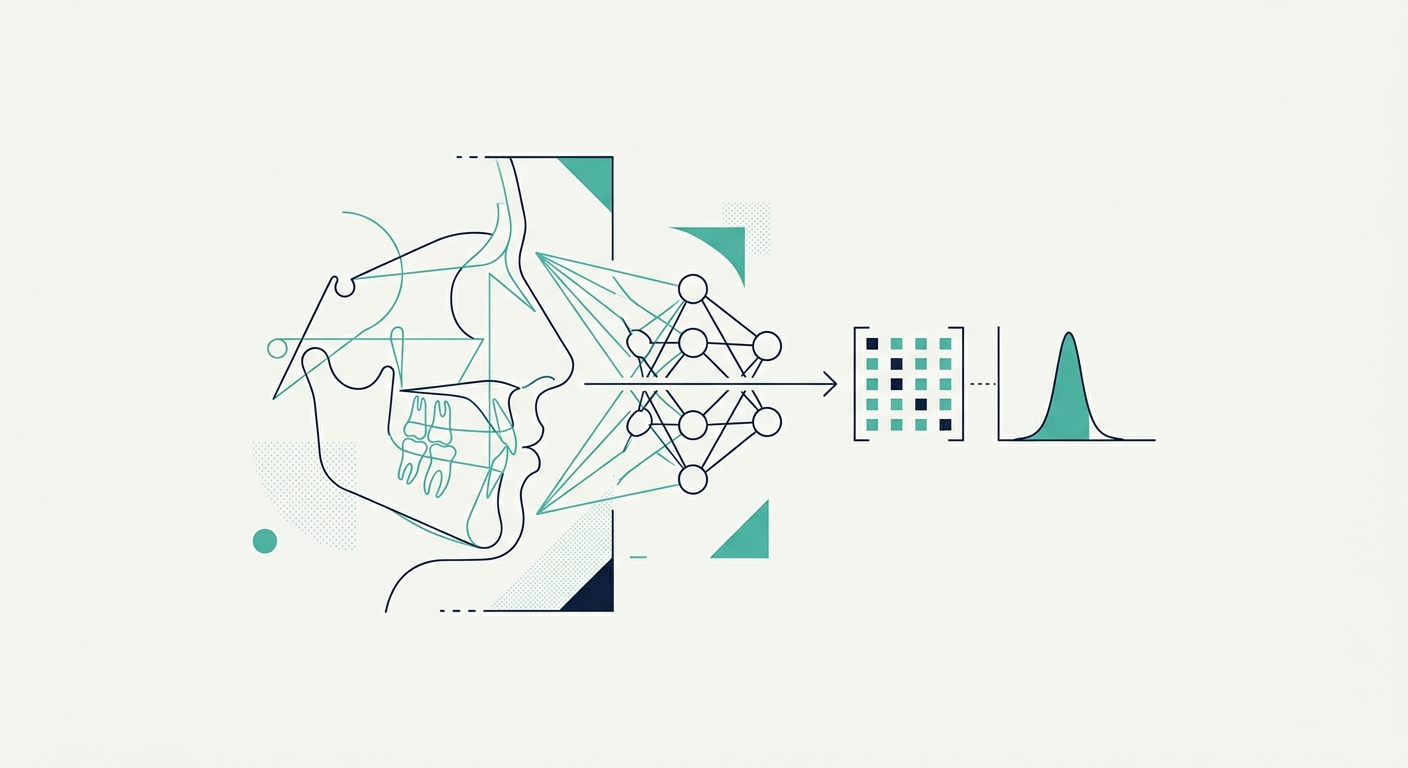
Skeletal maturity is most reliably assessed from a hand-wrist radiograph, which means an additional radiation dose. The authors asked whether the same information could be extracted from the radiographs the orthodontist has anyway. They retrospectively analysed 3,703 patients who, before orthodontic treatment, had a hand-wrist radiograph, an orthopantomogram and a lateral cephalogram.
The hand radiographs were classified according to the nine-stage Björk system, and the stages were then condensed into five-group and three-group schemes. Landmark detection was performed by YOLOv5 and classification by EfficientNet networks, with the clinical variables of age and sex included and five-fold cross-validation. Detection was reliable: tooth roots on the orthopantomogram with an accuracy of 92.5%, cervical vertebrae on the cephalogram with 98.9%.
Maturity classification showed a clear hierarchy. On the cephalogram, accuracy was 43.5% for the nine stages, 63.4% for the five groups and 89.8% for the three groups; on the orthopantomogram it was 36.5%, 53.1% and 75.2% respectively. The model therefore identifies the coarse division of growth well, the fine one not.
Limitations
The study is retrospective and was conducted on a single data set, without external validation in another population. Accuracy for the nine-stage Björk scheme remained below 50% on both types of radiograph, so that level of classification cannot be used clinically.
For your practice
- The model reads the coarse, three-stage division of skeletal maturity from the lateral cephalogram you already have, without an additional hand-wrist radiograph.
- Do not rely on the fine classification: 43.5% accuracy for the nine stages means the model misses more often than it hits.
- If a software manufacturer offers you a function of this kind, ask for validation data in a population similar to yours.