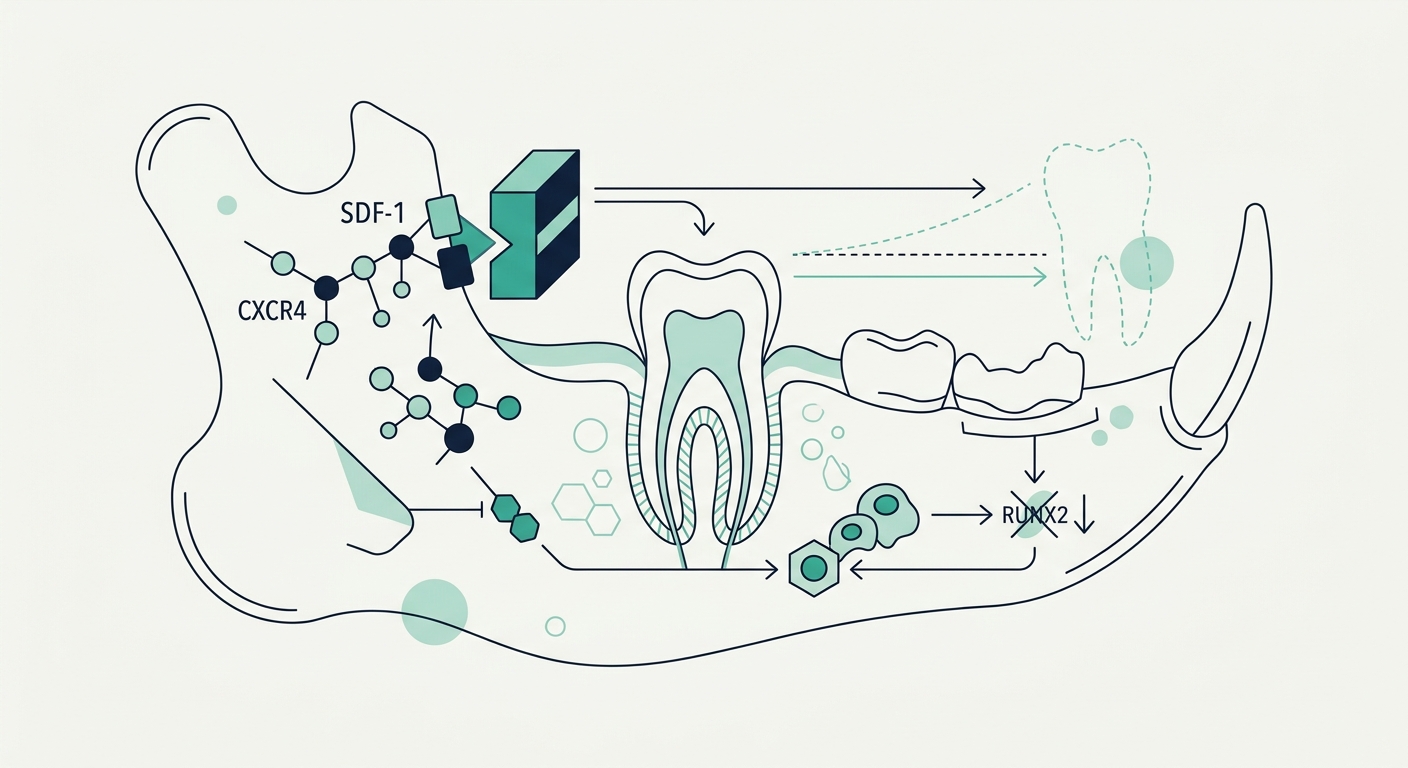
Blocking SDF-1/CXCR4 signalling reduced tooth movement in rats and suppressed RUNX2
In an experiment on 36 rats, local blockade of the CXCR4 receptor reduced the extent of orthodontic tooth movement and lowered the expression of SDF-1, CXCR4 and RUNX2 from day one to day seven.
The chemokine that summons the bone builders
For a tooth to move, bone has to be broken down on one side and built up on the other. Osteoclasts are well described in that account; less is known about what summons osteoblasts on the tension side of the periodontal ligament. Hamada's team examined one candidate — the chemokine SDF-1 and its receptor CXCR4.
Thirty-six male rats aged six weeks were divided into a control and an experimental group. After extraction of the upper left first molar, the second molar was moved mesially with a force of 10 grams, while buffered saline was injected into the surrounding gingiva in the control group and AMD3100 — a CXCR4 receptor antagonist — in the experimental group. Tooth movement and alveolar bone changes were measured by micro-CT, alongside histological, immunohistochemical and gene expression analysis.
The blockade slowed the movement: both the distance travelled and the angle of mesial tipping were significantly smaller in the experimental group. Expression of SDF-1, CXCR4 and RUNX2 was reduced from day one to day seven, while BGLAP fell only on day one. Immunohistochemistry showed fewer SDF-1- and CXCR4-positive cells on day three and fewer RUNX2-positive cells on day seven, while the proportion of BGLAP-positive cells did not differ at any time point.
The picture that emerges is narrow but clear: the SDF-1/CXCR4 axis acts in the early phase of tooth movement, and it acts on osteoblast differentiation via RUNX2 rather than on the later maturation of the bone matrix.
Limitations
The experiment was conducted on 36 rats, with a small number of animals per time point, and AMD3100 is a research tool, not a therapy. Follow-up covered the first seven days of tooth movement, so the study says nothing about the outcome at the end of treatment or about relapse.
For your practice
- There is no direct application — this is an animal experiment with a pharmacological blockade that is not used in patients.
- The practical message concerns timing: in this model the decisive events on the bone formation side took place in the first seven days of movement, not later.
- When a patient asks why the tooth is not moving faster, this is part of the answer: the speed depends on the cellular response in the ligament, and blocking a single signalling pathway was enough to slow the movement down.