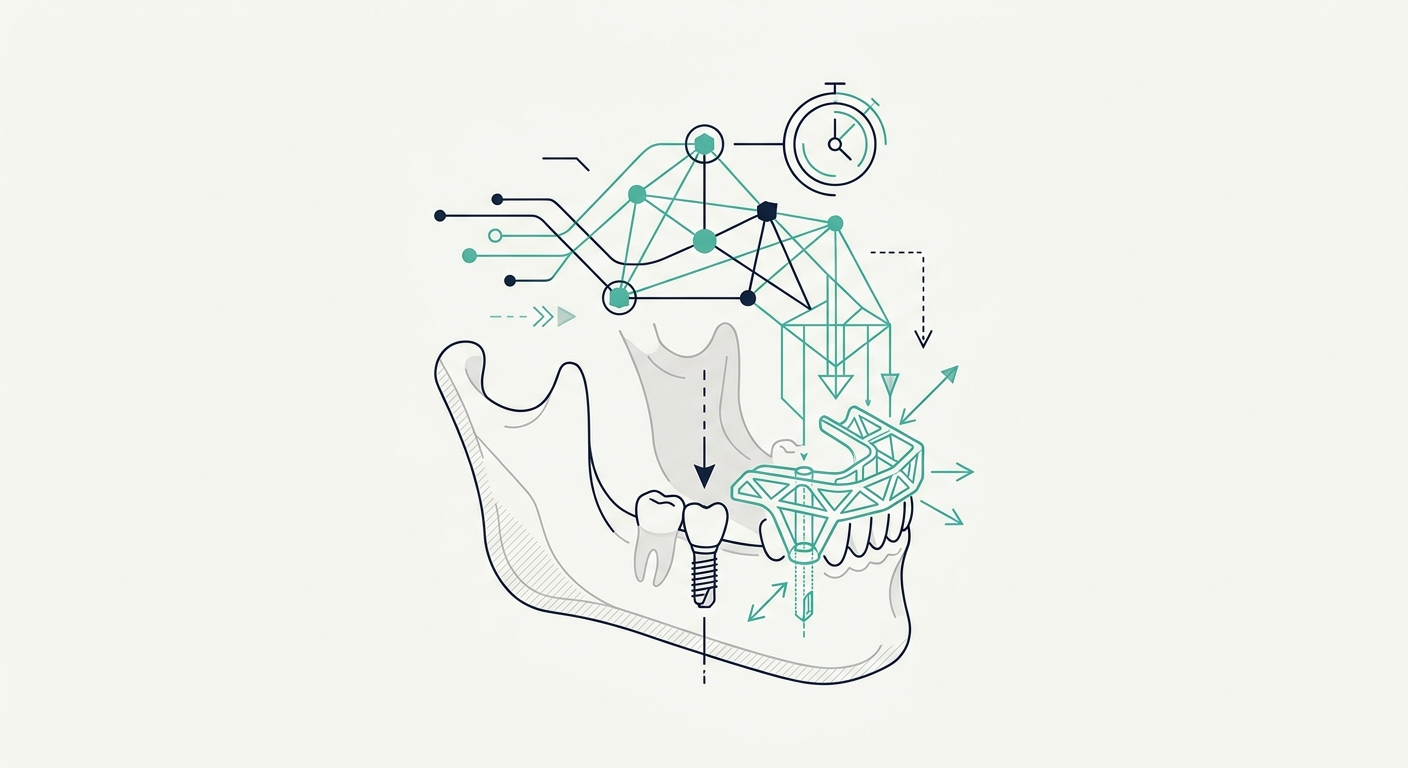
Artificial intelligence designed an implant surgical guide in 20 minutes
A case report in the British Dental Journal describes the automated production of a surgical guide for a single anterior implant in a 25-year-old patient: the design was finished within 20 minutes.
Data segmentation and alignment without manual work
Producing a surgical guide for an implant is still largely manual work. Someone has to segment the anatomical structures and align the CBCT data with the surface scan, which takes time and depends on the operator — two people working on the same data do not necessarily end up with the same guide.
A case report in the British Dental Journal describes a 25-year-old patient who needed a single implant in the anterior region. Data processing was left to deep learning architectures within a static computer-guided protocol, and the design of the digital guide was finished within 20 minutes. A visualisation of the future outcome was obtained together with the guide, which in the esthetic zone changes the course of the conversation with the patient. A static protocol means that the implant position is determined at the planning stage and the guide merely carries it out during the procedure, so the quality of the digital preparation feeds directly into the final implant position.
The authors attach a caveat to the report: automation does not remove the obligation to check the work manually. Artefacts in the data and the limitations of the algorithm itself remain a risk the clinician has to intercept before the guide is printed and placed in the mouth.
Limitations
This is a single case report, with no measurement of the deviation of the placed implant from the planned one and no comparison with a conventionally produced guide. Funding information is not stated in the abstract, and no conclusion about more complex indications can be drawn from a single patient.
For your practice
- The saving is in the design, not in the surgery: planning is shortened, while the verification protocol before the guide is printed stays the same.
- Go through the automatic segmentation slice by slice on the CBCT before ordering the guide — the algorithm errs silently, without an error message.
- Use the instant outcome visualisation for informed consent in the esthetic zone, but do not present it as a guarantee of the result.