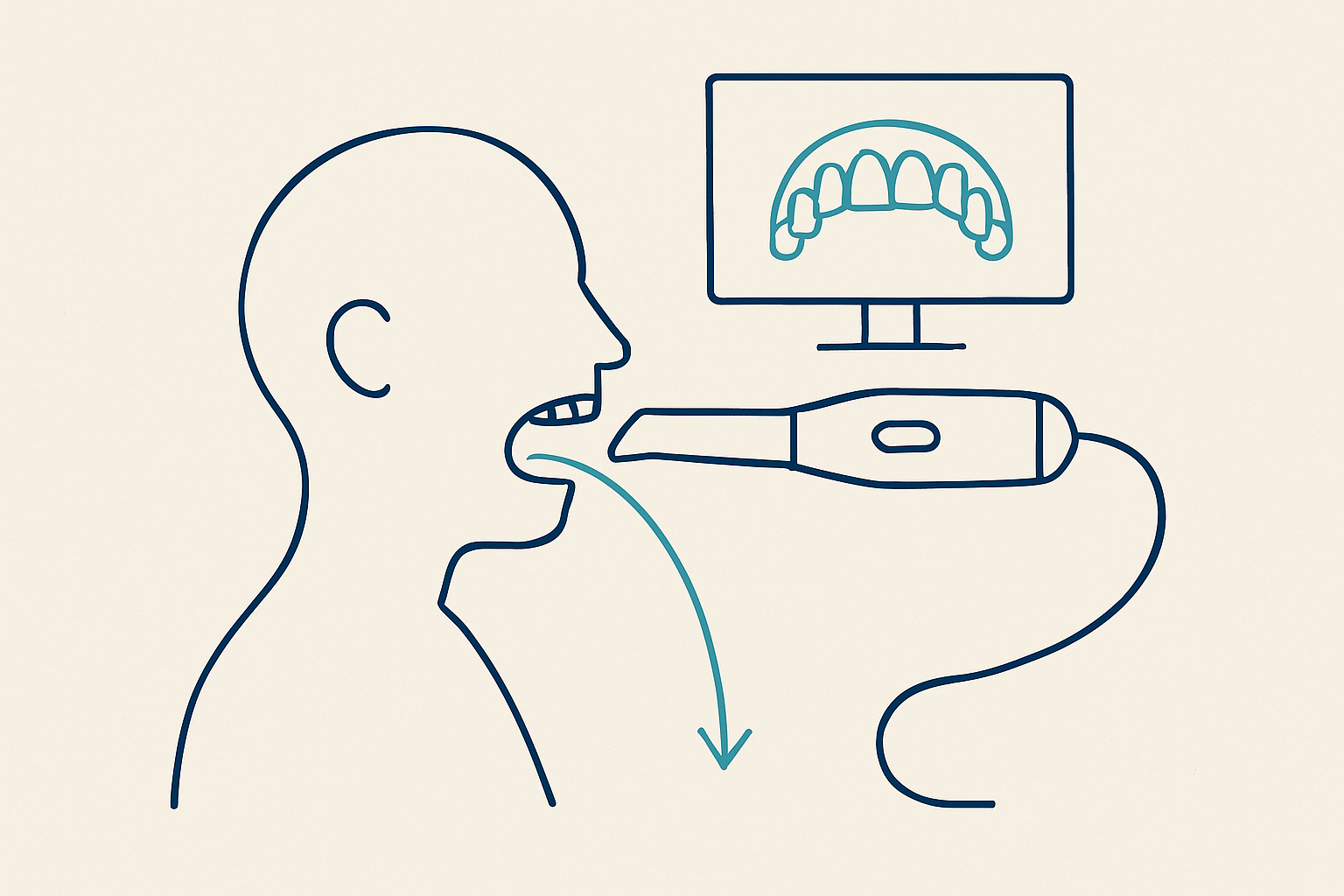
An intraoral scanner in dementia: gag reflex in 5 percent instead of 47
In a feasibility study in 19 hospitalised people with dementia, bedside scanning triggered a gag reflex in one of 19 (5.3 percent), against nine (47.4 percent) with an alginate impression. Reported discomfort had a median of 1.0 against 7.75.
Bedside scanning instead of alginate
Researchers around A. L. Hillebrecht published in JMIR Formative Research a feasibility study in which 19 hospitalised people with dementia on a geriatric ward underwent two procedures at the same visit: bedside intraoral scanning of the upper jaw and a conventional alginate impression. Mean age was 83.5 years (SD 3.4) and the mean Mini-Mental score 18.2 (SD 4.8). The order of the procedures was not randomised but alternated, to cancel out an order effect.
The primary outcome was feasibility, defined as completing the procedure without interruption because of a gag reflex, defensive movements, refusal or withdrawal of consent. The differences were large. Discomfort reported by participants themselves had a median of 1.0 with scanning against 7.75 with alginate (p < 0.001), and clinicians rated scanning easier to perform (median 2.0 against 5.0; p < 0.001). A gag reflex occurred in one of the 19 during scanning (5.3 percent) against nine of 19 with the impression (47.4 percent; p = 0.004).
Active bedside working time was practically the same: 3.02 minutes (SD 0.72) for the scanner and 2.92 minutes (SD 0.78) for the impression. The gain, then, is not speed but the fact that scanning can be paused and resumed.
Limitations
A single-centre, non-randomised feasibility study in 19 participants; effects on later treatment were not measured, and transferability outside the hospital setting remains unverified.
For the practice
- In patients with dementia, a pronounced gag reflex or poor tolerance of procedures, consider scanning instead of alginate even when the impression looks straightforward.
- Do not promise time savings: in this study the duration was the same, and the advantage is the option to pause and continue.
- A mobile scanner opens the possibility of capturing data at the bedside, in care homes and on wards, which is exactly the setting this study tested.