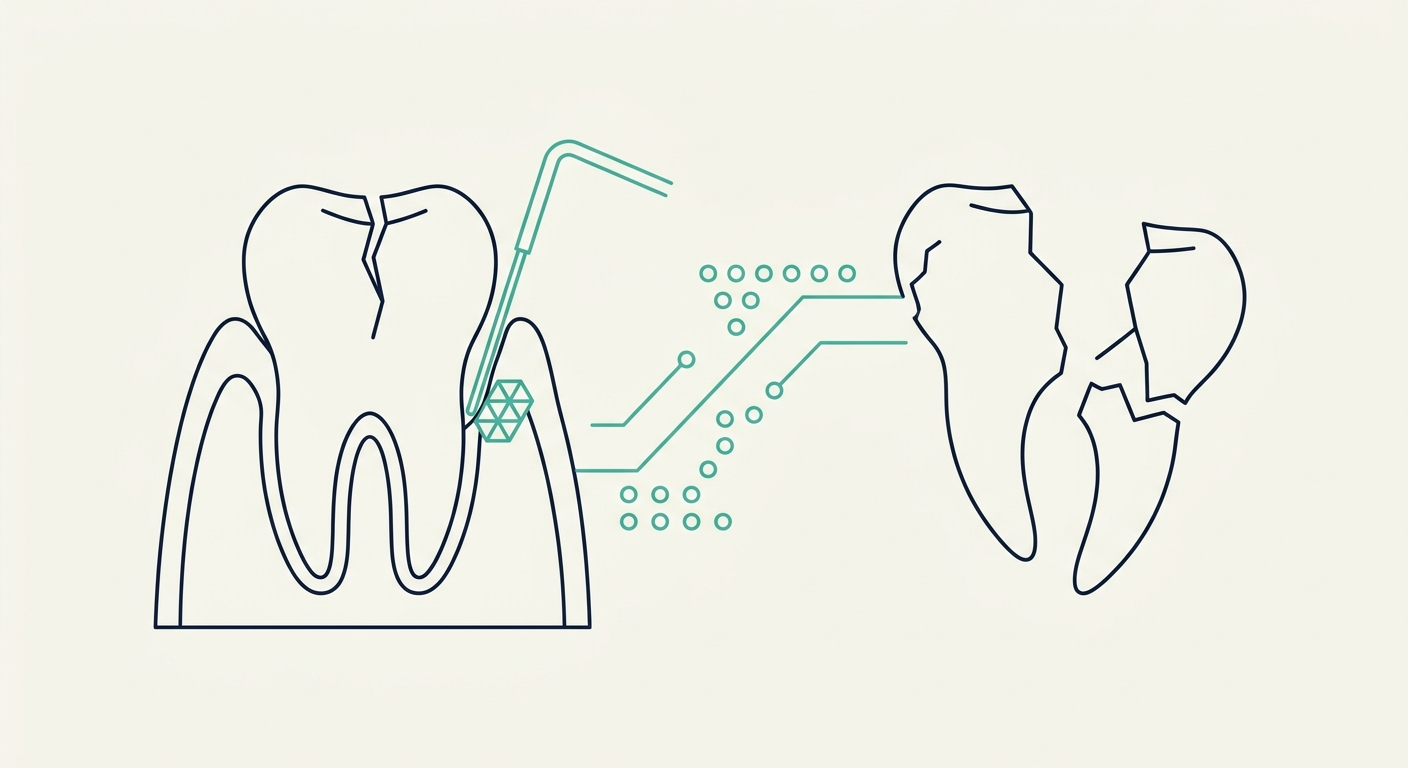
A pocket deeper than 5 mm triples the odds of losing a cracked tooth
A retrospective analysis of 295 cracked teeth with chronic irreversible pulpitis gave five-year survival of 89.9 percent. Probing depth greater than 5 mm was the only factor that increased the odds of loss (OR 2.99), while a crown and treatment in two to three visits were protective.
Three variables that decide the five-year outcome
A cracked tooth with chronic irreversible pulpitis is an awkward case: it can be managed endodontically, but how long it will last is hard to tell the patient in the chair. The team around Dong retrospectively analysed 295 patients with 295 affected teeth, treated between January 2017 and January 2020, and followed tooth retention over five years.
Five-year survival was 89.9 percent, 265 teeth in the surviving group against 30 lost. After variable selection by Lasso and binary logistic regression, three independent predictors remained. Endodontic treatment in two to three visits was protective (OR 0.15; 95% CI 0.05–0.50), as was a crown (OR 0.28; 0.09–0.83). Probing depth greater than 5 mm was the only factor that increased the odds of tooth loss (OR 2.99; 1.26–7.09).
On those three predictors the authors built a nomogram in R, a scale that computes the probability of tooth loss from clinical data. The discrimination of the model is moderate: the area under the ROC curve is 0.73 (0.62–0.84). Calibration is good, with a Hosmer-Lemeshow test of p = 0.682 and a curve that tracks the ideal closely, and decision curve analysis showed clinical benefit across a risk threshold range of 4 to 68 percent.
Limitations
This is a retrospective analysis from a single institution in a specific population. The authors themselves caution that the sample is limited, that the findings do not necessarily transfer to the general population and that the model needs external validation across several centres.
For the practice
- Probe before you pronounce a prognosis: a pocket deeper than 5 mm on a cracked tooth moves the conversation about alternatives to before endodontic treatment, not after it.
- A crown after root canal treatment of a cracked tooth is not an aesthetic extra but a predictor of survival. Plan it both in the cost estimate and in the sequence of treatment.
- The figure that 89.9 percent of teeth survived five years is useful for the patient who refuses treatment convinced the tooth is lost anyway.