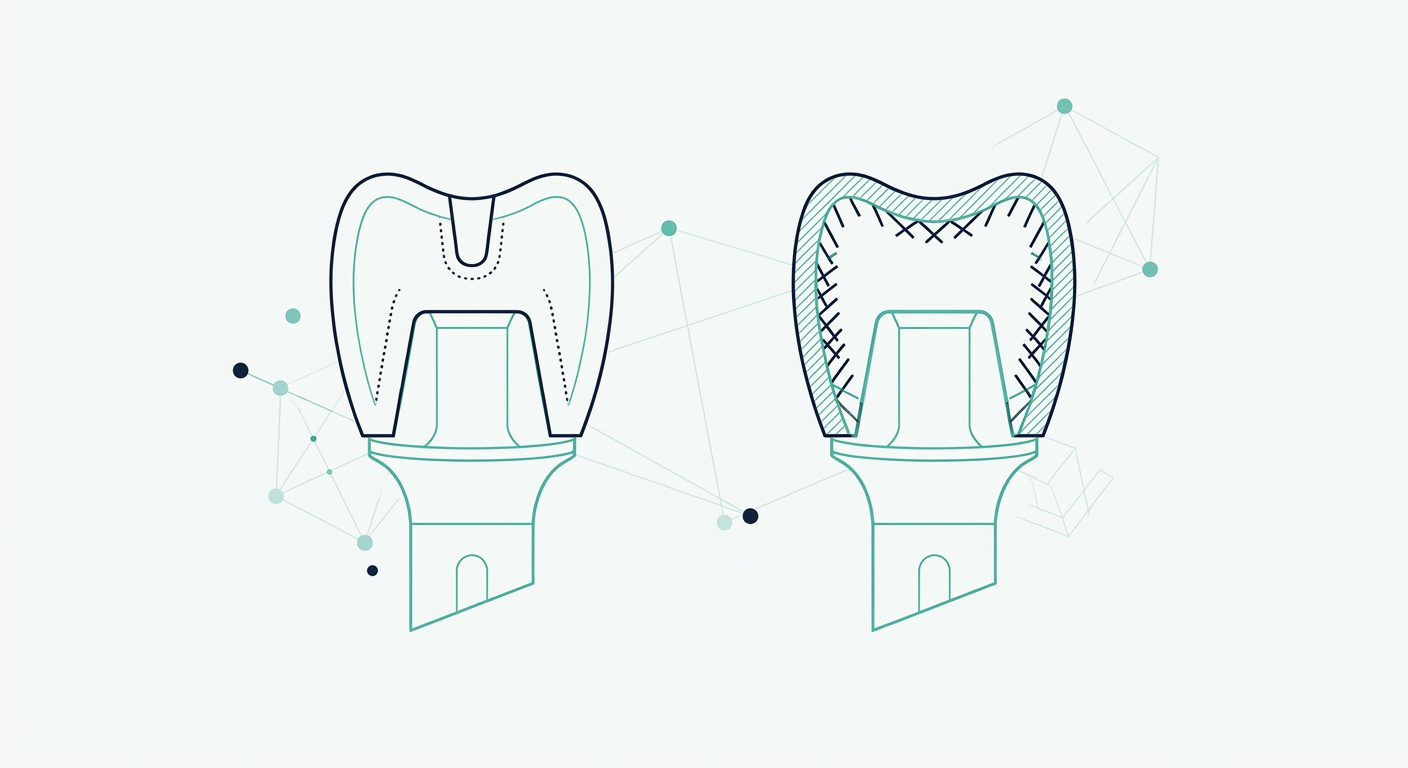
A groove in the crown does not strengthen the bond to the titanium base, coarser sandblasting does
In an in vitro experiment with 90 titanium bases, zirconia crowns on a more coarsely sandblasted base withstood 1298 N before debonding, compared with 1085 N in the control group, while an additional retention groove brought nothing.
More roughness helps, additional geometry does not
Two-piece hybrid abutments — a CAD/CAM crown adhesively bonded to a prefabricated titanium base — have an obvious weak point: the adhesive joint itself. The team led by Grander tested two ways of strengthening that bond: a circumferential retention groove cut into the inner surface of the crown and a more aggressive sandblasting protocol for the titanium base.
The experiment involved 90 titanium bases, 45 zirconium oxide and 45 PICN crowns (polymer-infiltrated ceramic network), allocated to six groups of 15 specimens. The control groups received the customary treatment: for zirconia, sandblasting of the titanium base and of the inner surface of the crown with 50 µm aluminium oxide at 1.0 bar, an MDP primer and cementation with the Panavia V5 system, and for PICN, the same sandblasting of the base together with etching of the crown with 5 per cent hydrofluoric acid and dedicated primers. After thermocycling, the force required to debond the crown was measured.
The groove acted contrary to expectation. Zirconia crowns with a groove failed at 1017 N ± 65 and without it at 1085 N ± 79 (p = 0.024); with PICN the difference was larger — 438 N ± 48 with a groove versus 664 N ± 68 without it (p < 0.001). Coarser sandblasting of the base, with a grit of 250 µm at 2.0 bar, acted in the other direction: 1298 N ± 98 for zirconia (p < 0.001) and 744 N ± 64 for PICN (p = 0.0023). Surface roughness differed significantly between the differently sandblasted bases (p < 0.001).
Limitations
An in vitro experiment with one cement system and one form of retention groove; tensile-shear loading after thermocycling does not reproduce masticatory loading in the mouth. The authors themselves note that the conclusion about the groove holds at least for the form in which it was made here.
For your practice
- If you are discussing the durability of hybrid abutments with your laboratory, the parameter worth checking is the sandblasting protocol for the titanium base, not additional geometry in the crown.
- PICN withstood a markedly lower force than zirconia in all groups (664 N versus 1085 N in the controls) — a figure worth keeping in mind when choosing the material.
- The coarser sandblasting protocol from this study is a laboratory parameter; the instructions of the manufacturer of the titanium base and of the cement still take precedence.