A fractal titanium surface raised mineralisation by 60 to 80 percent in vitro
On titanium with a fractal pattern produced by selective laser melting, alkaline phosphatase activity and mineralisation were 60 to 80 percent higher than on a smooth control, and fractal dimension contributed to proliferation independently of roughness.
Surface geometry does what roughness alone cannot
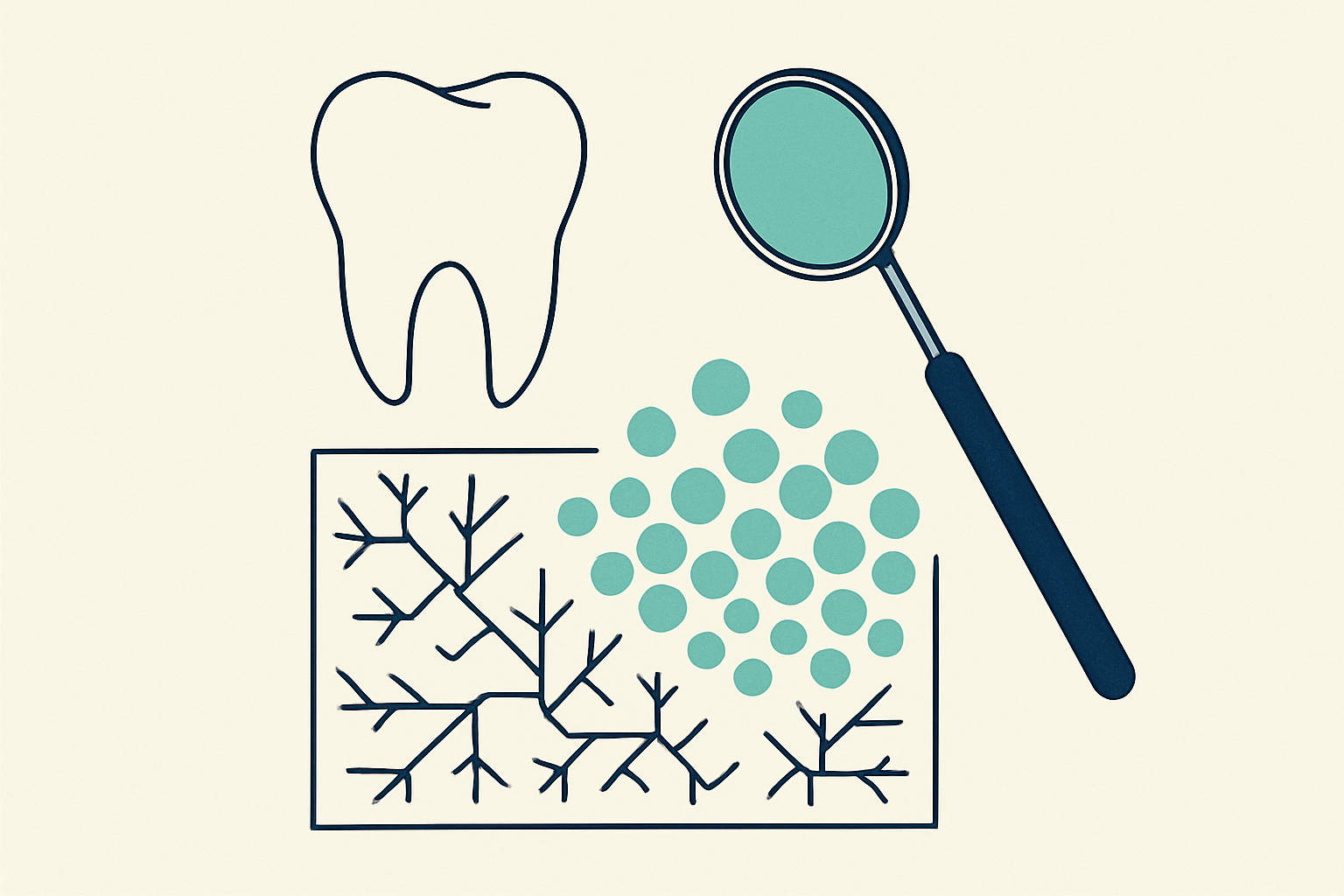
For decades implant surfaces have been optimised by grinding, etching and blasting, that is, by random roughness. The group around Chen took a different route: instead of a random texture, they imprinted mathematically defined fractals onto titanium by selective laser melting (SLM), a Koch snowflake and a Sierpinski pentagon, in several hierarchical iterations.
Rat bone marrow mesenchymal stem cells were seeded onto the prepared specimens, with smooth titanium as a control. Cytotoxicity, adhesion, proliferation and osteogenic differentiation were followed, by CCK-8 assay, live/dead staining, DNA quantification, alkaline phosphatase activity, alizarin red staining and expression of the BMP2, RUNX2, OCN and COL-1 genes.
The fractal surfaces had more pronounced hierarchical roughness and better hydrophilicity than the control, with sound cytocompatibility. From day seven onwards, adhesion, proliferation and osteogenic activity were significantly higher, and higher iterations gave better results than lower ones. The most interesting finding comes from multiple regression: fractal dimension contributed to cell proliferation independently of roughness itself (β = 0.38; p = 0.04). At higher iterations, alkaline phosphatase activity and mineralisation were 60 to 80 percent higher than on the smooth control. The authors tie the mechanism to mechanotransduction: the fractal geometry activated Piezo1 mechanosensitive channels and increased ATF4 expression.
Limitations
An in vitro study on animal cells, without loading, without bone and without biofilm; a whole chain of preclinical and clinical steps stands between this and any conclusion about osseointegration in a patient.
For the practice
- Nothing changes in practice today: this is a laboratory concept, not an available product.
- The claim worth remembering is that roughness and geometry are not the same, so a single roughness figure in a catalogue does not describe the whole surface.
- In patients with questionable healing potential, the familiar factors still decide: primary stability, the surgical protocol and control of loading.